
 Site Explorer
 Keyword tool
 Google Algorithm Changes

A topic worth revisiting is how search engines handle diacritics in modern SEO. That is, how accented and non-accented characters (like “é” vs “e”) affect search visibility and organic performance. In this article, we look at how Google interprets diacritics today and what this means for search traffic in multilingual environments.
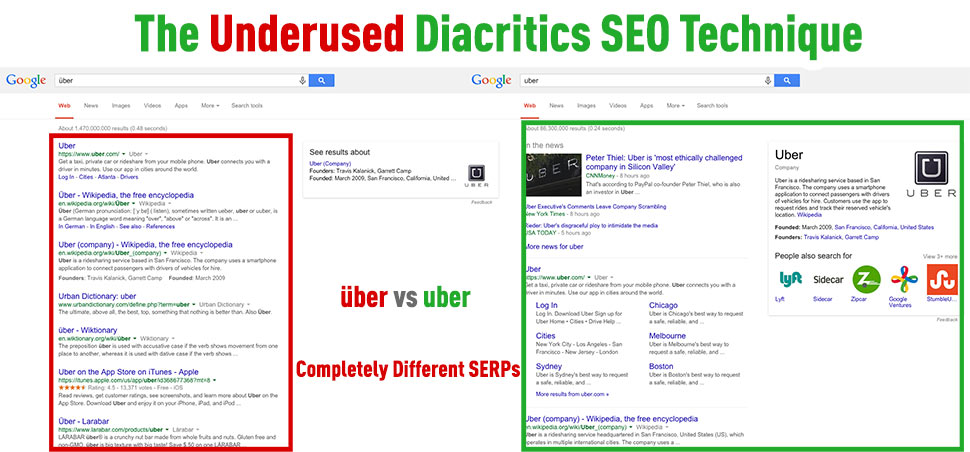
Let’s get straight to the point with an example. Is there a difference between searching for “Haagen Dazs” versus searching for “Häagen Dazs”? I know they’re probably some ice-cream producer from Denmark (it sure sounds like they could be, and they definitely sound old), but why did they have to make their name so difficult to spell? Where do I even find those two dots to put on the “a”? I don’t care what it’s called, why won’t they just let me look for my ice-cream?
A diacritic is a mark added to a letter that can change pronunciation, meaning, or grammatical function depending on the language. You might remember the acute, grave and circumflex accents from your high school french class? It’s exactly like those, only there’s a much larger variety of diacritics than just those. All of the following are diacritics and none of them sound like the letters they are based on: á, í, ó, ú, ý, ø, å, ä, ö, â, ê, ï, ș, ț, č, ć, đ, š, ž, ā, ē, ī, ū, č, ģ ķ, ļ, ņ, ą, ę, ł, ń, ś, ź etc. Even though they can be found in languages all over the world, regardless of the alphabet that is used (including languages that use Latin scripts as well as transliterated forms in other writing systems), for simplicity we are just going to refer to examples from the Latin alphabet.
French is probably the first example that springs to mind, followed shortly by German. In fact, all Germanic languages (Danish, Icelandic, Swedish, Norwegian) use diacritics to some extent. Several other language families are quite keen on diacritics: Slavic (this includes Bosnian, Croatian, Serbian, Czech, Polish, Slovak and Slovene), Baltic (meaning Latvian and Lithuanian) and Finno-Ugric (with the unlikely related Estonian, Finnish and Hungarian). These aren’t even all the languages containing diacritics from the ones using Latin alphabets. The world of languages is full of mysterious, and weird accents – at least to the eye of the English speaker. But even he (or she) must admit that these accents can lend specificity to certain words, especially when applied to imported words.
English too, it seems, has taken a linking to these funny accents, which is why we refer to our future husband or wife as our “fiancée” (and not spelling it with the accented first ‘e’ is underlined in red, as a grammar mistake, by your spelling processor). The acute accent is quite popular, in fact, as it is found in several more or less popular words such as “café”, “cliché”, “résumé”, but also “exposé”, “maté”, or “risqué”. But the acute accent on ‘e’ is not the only instance of a diacritic being used in English. Examples also include words like “jalapeño”, “naïve” and “pâté”, not to mention brand names such as “Löwenbräu”, “Škoda” or “Citroën.”
How does Google Rank Sites for the Same Keywords with and without Diacritics ?
Does any of this matter from a SEO perspective? Will you get different results for “Skoda” than for “Škoda”, or for typing “Motorhead” instead of “Mötorhead”? If your language is keen on diacritics, should you be too?
If you are in the SEO business, the question you want to start with is how Google ranks sites for the same keywords with and without diacritics.
The answer today is: mostly not in a meaningful ranking sense. Let’s take a look at the screenshot below and clear things up.
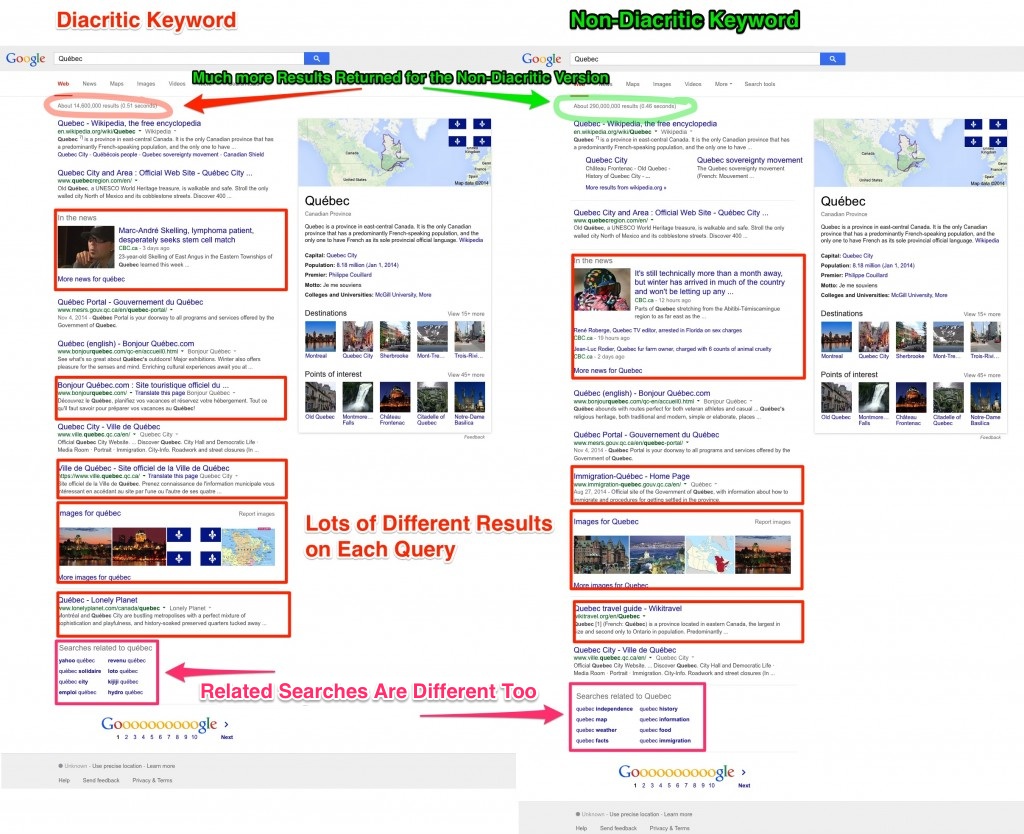
Searching for “Quebec” vs “Québec” generally produces highly similar results today, with Google normalizing most diacritic variants in indexing and ranking. The answer box and the first two results are the same in both cases: the region’s Wikipedia page and their official site (in exactly this order). Minor variations may still appear, but they are typically related to personalization, language detection, or query context—not strict character matching. Historically there could be indexing differences, but modern Google indexing does not produce such large disparities for diacritic variants in most languages. The results on the first page are also different.
There are some similarities on the first page, but not in the same order and not everything found in one case is reflected in the other. The images are also slightly different. Better yet: the related search box is different: the diacritic spelling suggests “québec solidaire”, “emploi québec” “revenu québec”, “loto québec”, while the non-diacritic spelling suggests “quebec independence”, “quebec map”, “quebec weather”, “quebec food”.Today, differences in intent are usually driven by query language, location, or user behavior signals rather than the presence or absence of diacritics alone.
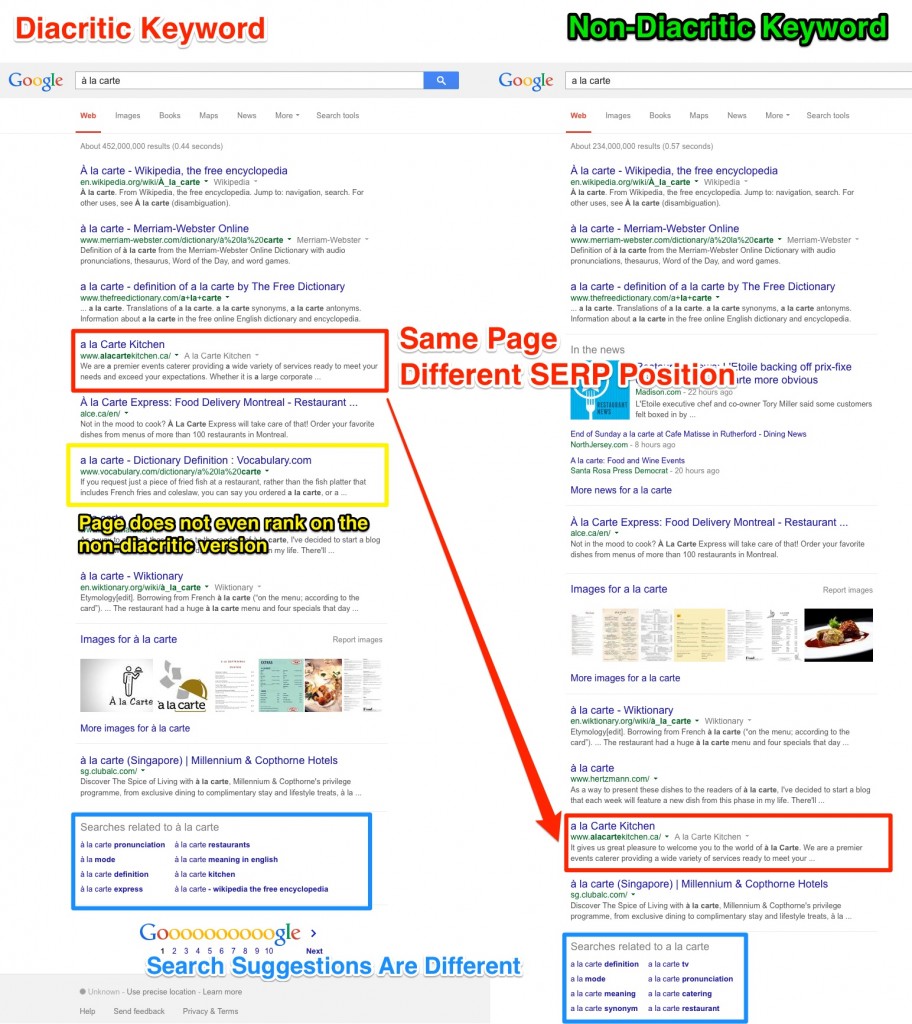
Another example that you can see in the image above is “a la carte”. Or, for the connoisseurs, “à la carte.” The number of search results favors the public in the know this time, with almost twice as many results for “à” than for “a.” A less dramatic difference, at any rate. When it comes to the order of results, however, things get complicated. The page “a la carte kitchen”, for instance, shows 4th for the diacritic search but almost at the bottom of the page for the non-diacritic search.
The vocabulary entry for “a la carte” does not even rank on the first page of the non-diacritic search. Related search suggestions tend to tell the same story as before: different audiences might be using different spellings. The first recommendation for those who like their “a” clean is “a la carte definition”, while for those who are not afraid of a little accent its “a la carte pronunciation”, suggesting a more sophisticated enquiry into the topic.
Does Google Consider Diacritic and Non-Diacritic Keywords Synonyms?
To bé or not to be a Google Search Geek 🙂
Honesty aside, the more relevant marketing question is:
Does Google consider diacritic and non-diacritic keywords synonyms?
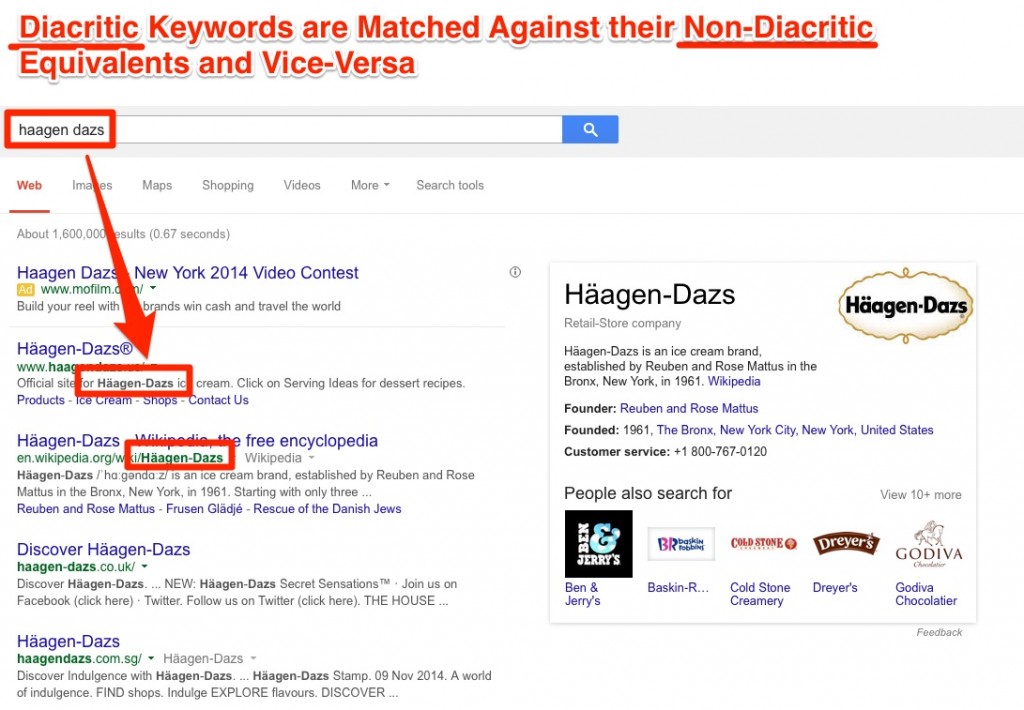
For most brands, it does, at least partially. Häagen-Dazs, for instance, reveals itself to you even when you are unworthy and spell it diacritics-free.
But what happens when we search for some other query that isn’t a brand? Let’s take résumé for instance. Whether we search for this keyword with its original writing, or we search it diacritics free, Google understand that it’s a Curriculum Vitae we are talking about and returns results related to this. Indeed, the results vary but they are all related to the same concept; they all give you information about how to write a resume or resumes’ templates. This means that the big G understands the user’s intent and provides him with relevant results instead of stumbling into exact matches searches.
The same thing happens when, for instance you search for “école française”, “ecole francaise” or a combination of the two like “école francaise”. The results do vary tremendously but what is important to mention is that Google understand that is a French school you are searching for and provides you with results accordingly to your intent.
How to Spot if Your Site is Bleeding “Diacritic” Traffic?
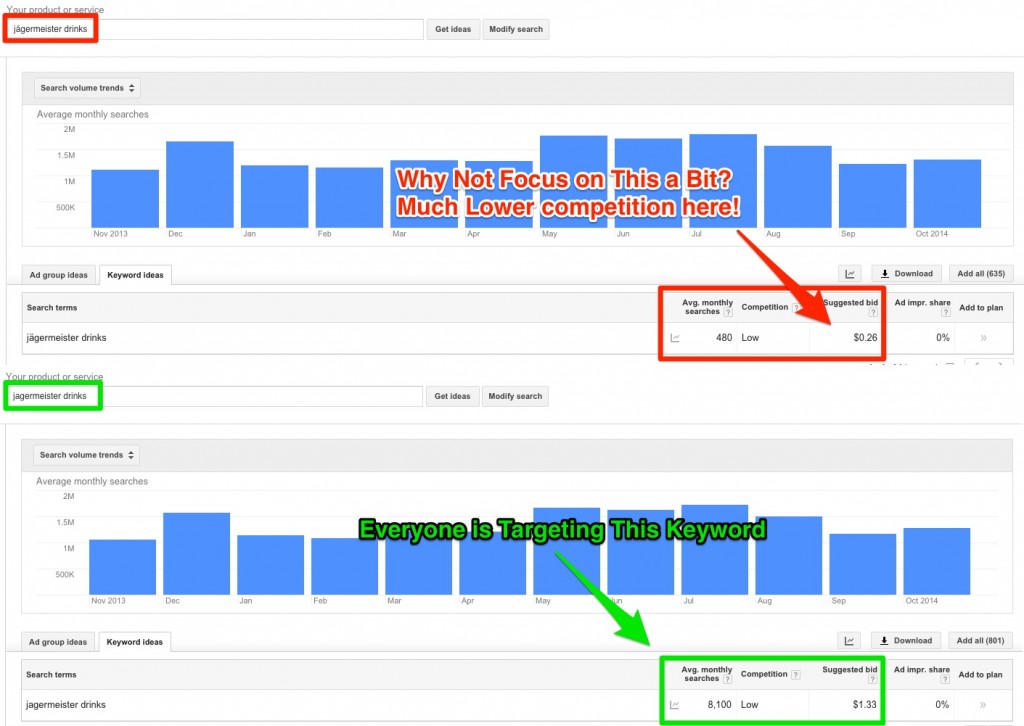
Sometimes you want to fish in the big pond, while other times it might be worth your time focusing on the small pond. Jägermeister is not just a famous hunters’ drink (the name when literally translated means “master of hunters”) but also a good example of how a business can save money.
It seems that barely anyone is searching for “jägermeister” (although that is the correct spelling) and most people are searching for “jagermeister” (almost 17 times more than the first category).
Who is looking for the diacritic version? Is it just Germans or is there an extremely loyal fan base that is really crazy about correct spelling? As Matthew McConaughey’s character in the recent Interstellar movie would encourage, you need to take your observations further and draw some conclusions from them. After all, the market for “ä” might be several degrees of magnitude smaller than the market for “a”, but it’s also about 5 times cheaper to advertise on it. So if your business is also smaller, or in its infancy, the best thing for you might be to take advantage of that and go for the less competitive market.
Linguistic Precision: Why Basic Brand Trackers Fail
Beyond search visibility, diacritics also point to a broader challenge in digital analytics: the need for linguistic precision when tracking brand mentions across languages and regions.
In multilingual environments, small variations in spelling, accents, and local usage can affect how accurately online conversations are captured and interpreted. This is especially relevant in brand monitoring, where missing or misclassifying mentions can distort the overall picture of sentiment and reach.
Some entry-level tracking tools rely heavily on exact keyword matching, which can limit their ability to capture these variations consistently across languages.
More advanced social listening platforms, such as BrandMentions, take a more contextual approach, analyzing mentions across multiple languages and focusing on semantic meaning rather than strict character matching.
This allows for a more complete view of how brands are discussed globally, including variations that would otherwise be missed in basic keyword-based systems.
Important Tips to Better Optimize Your Site for Diacritics
Obviously there is some overlap between searches, but there are also relevant differences. Is there a way to use these differences to your advantage?
Follow the Accent and Optimize Your Site!
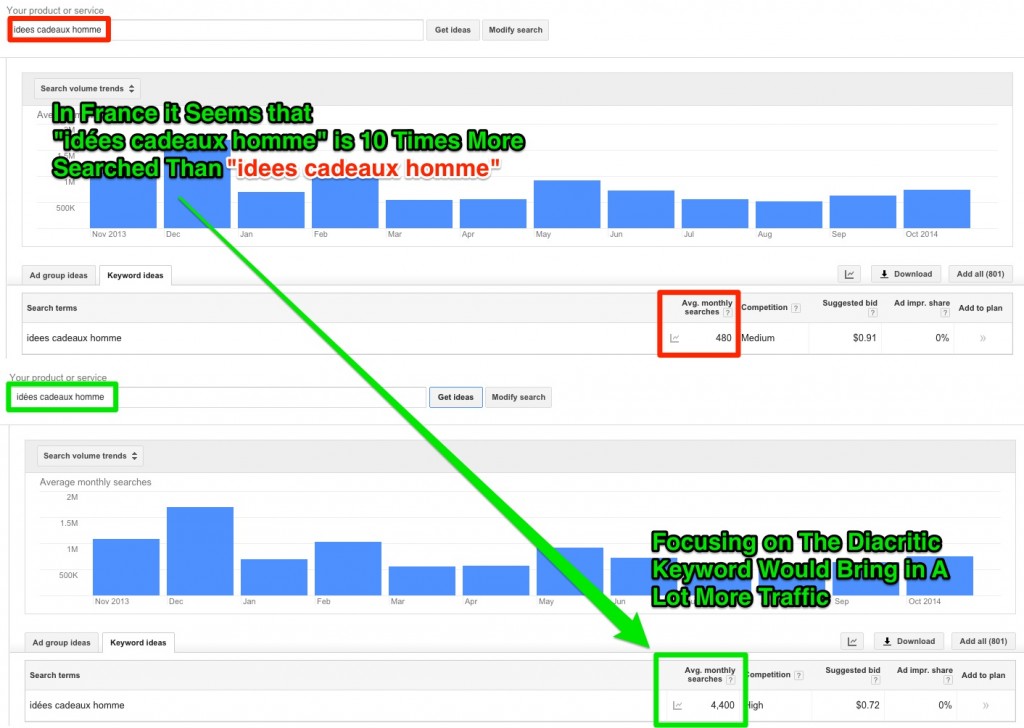
Say you were looking for a gift idea for someone you don’t know well enough (yes, we know it’s a bit early for Christmas examples, so let’s just assume it’s a birthday). If you were French, or in France, or for whatever reason did the search in French, you might be interested in knowing that the phrase “idées cadeaux homme” is almost 10 times more searched than simply “idees cadeaux homme”. They seem to be very fond of the specificities of their language – and there’s nothing wrong with that. But this is something to take into account if you are in the business of gift ideas for men targeted at French-speaking (or simply French-searching) audiences.
If you are targeting multilingual or local audiences, include the correct diacritic forms naturally in content, but avoid keyword stuffing or duplicating variants unnaturally. Just know that every other site is doing the same. If, however, you are going for a less populated but perhaps also a less competitive market, then make sure to also include the non-diacritic version of the same key words. It’s also worth trying to figure out who uses the non-diacritic version of the phrase: is it French people who are not in France (and hence might not easily find their beloved accents on our keyboards)? Is it foreigners who are visiting France (and for some reason feel compelled to do as the French do)? Is it young French nationals who simply don’t feel like adding in the diacritics? Whoever they are, there might be some unique thing they might benefit from marketing-wise, in addition to finding what they searched for.
So, if your site is specific to a particular country and the people from that country use diacritics, you can do a bit of marketing research by testing generic keywords that have considerable traffic and seeing whether the diacritic or non-diacritic version draws the largest numbers. Extrapolating from that, you could make several assumptions on who and when (or even if) uses diacritics in their searches.
It’s just a diacritic.. or is it a strong marketing tool?
Of course, sometimes the accent itself might be a marketing tool. Take Haagen Dazs, for example. Or is it Häagen-Dazs? It could have been either, since the name was invented in New York and doesn’t actually mean anything in any language. But it does have that frosty, exquisite feel to it, doesn’t it? That’s exactly what the marketers wanted. Genuine or not, the diacritic is part of the name now, as is for several other brands (and bands as well: Motörhead isn’t really of Germanic descent, but they sure sound more menacing like that, don’t they?)
Should you or Should You Not use diacritics?
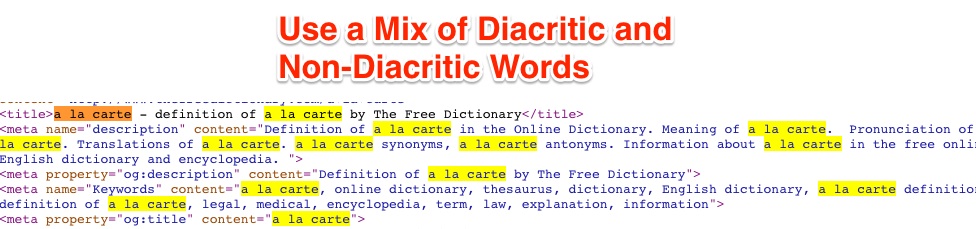
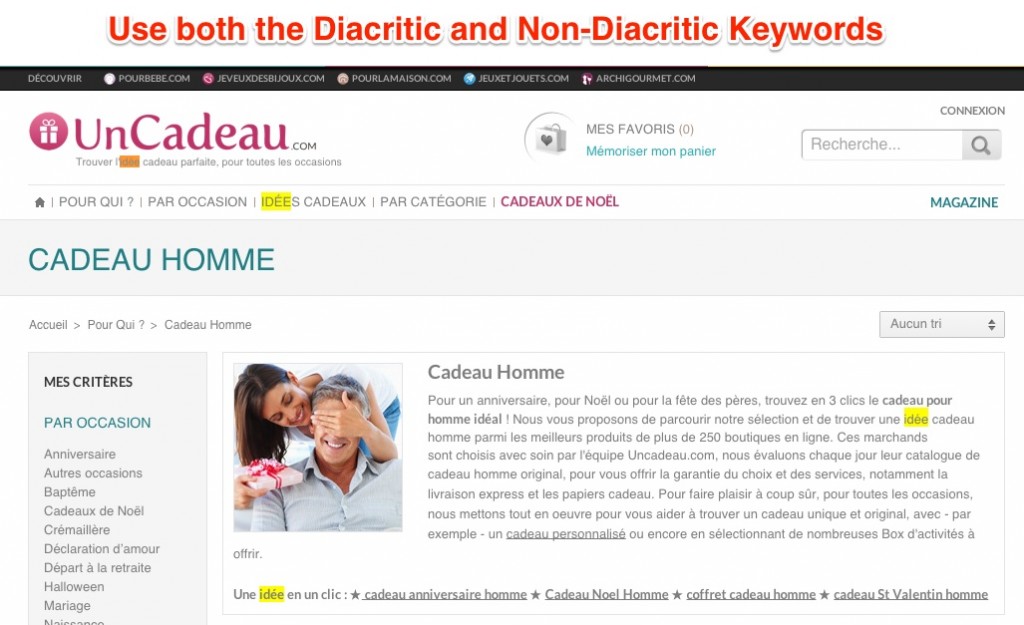
The answer is yes and by that we mean: use both. If your brand or product category has diacritics in its spelling give Google a helping hand by using both spellings alternatively in the content you publish on your site. Whether it’s “a la carte” or even “Haagen Dazs”, simply use a mix of diacritic and non-diacritic spelling in descriptions and as meta keywords. This not only increases your chances of ranking high for two (or more) different searches, but it also contributes to teaching the search engine – in the long run – that the two different spellings are actually synonyms for most intents and purposes. Of course, traditional criteria such as readability or usability should also be taken into account when making the decision about spelling. Certain areas, such as footers, might be better off with diacritic-free text.
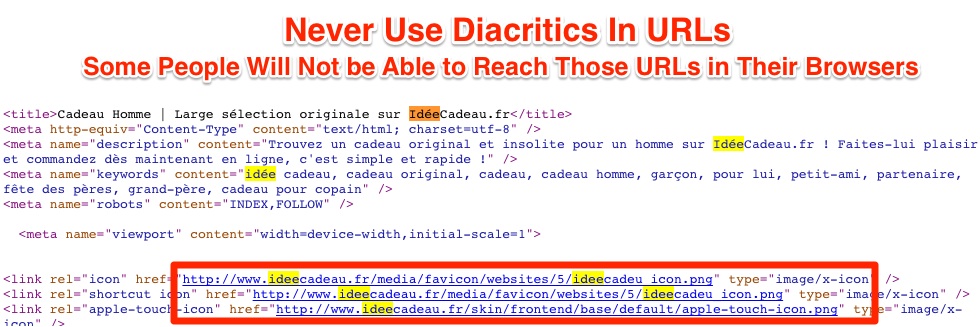
Should I Use Diacritics in URLs?
Modern systems allow Unicode URLs (including diacritics), but it is still best practice to use clean ASCII slugs for usability, sharing, and compatibility. Entering the URL with diacritics will be extremely bothersome for anyone who does not have the keyboard set up for the necessary language and in many cases it might be simply too much of an effort for users just to be able to go to your website.
Conclusion
On Google, no one can hear you enunciate. Yet, it seems that Google does take into account the way we search for different keywords: with or without diacritics.
Diacritics are no longer a separate SEO “technique” in modern search engines. Google typically normalizes accented and unaccented characters, so the focus should be on intent, language targeting, and content quality rather than character variations. As an online marketer or a SEO expert, you might be loosing millions of opportunities daily just by ignoring the “diacritics” aspect. And if you think that this is a matter that doesn’t affect you, just because you are on the English market, think again!
This whole diacritics story might look complicated but the truth is that it is not as hard as you’d think to optimize your site to be “umlauts friendly”. You can analyze your traffic potential just by looking at your targeted keywords, with and without diacritics, and chose the best version out of the two. Once you’ve identified which version suits you better, with or without diacritics, all you have to do is optimize your site’s content.






Thanks for this Great article! This is the first time I’ve heard of Diacritics SEO technique and how to make use of it. I would like to categorize it a technique in advanced SEO.
It’s really great how you can use keywords like jägermeister where there is more searches and less competition than jagermeister. Using Mix and match and otimizing site’s content accordingly you can easily rank for both the keywords.
Thanks again, It will really help me for the future seo.
it is underused. People do not optimize for it 🙂 and let Google decide for them. they should.
Great post and great find. This has a lot to do with taxonomic classifications. Trying to find meaning between words – or in this case, when they’re clustering a group of keywords together, they’re looking for where these words appear and next to what kind of content in general to provide context for the word/phrase.
This goes to show how important keyword research is… That audience will be different, minorly or majorly, from those who search for the keyword in other ways. You’ve got to optimize for the search that makes the most sense to your audience. Luckily when Google use their taxonomy classifications to understand the pages that use the word/s and the way people search for them you’ll be able to get a big hint from the kinds of sites showing up on the SERPs themselves. Keyword research needs to go deeper than just using your favorite program, need to actually manually check the SERPs too and check for the differences and different ways keywords can be searched.
good point with clear details, well done 🙂 btw as any good SEO activity all begin with a deep keyword analysis!
Once again you blew my mind Razvan! Time to retype some words in our blog..
Oh! I just notice it, I never even think of it before. But would Google give importance for Diacritic keywords, I seldom heard of it and most people doesn’t even have it in their computers. Users search for the easiest possible way in Google without giving attention to hyphens, diacritics, etc. And, business should focus on what the customer need and wants. With this, I don’t think that, diacritics seo technique would last in online market. Anyway, you have a very informative and post in here. Thanks for sharing your thoughts!
Diacritics SEO!! An Awesome read. Great inside you shared. Thanks for writing such awesome post on a new SEO Technique.
Hi, Razvan
I just went through your post it was really great Its my first visit here I was always curious about how the same keywords used by two different sites get ranked. It was an eye opener. 🙂
Wow, this is new information that we are glad to know of. Thanks!
Excellent article! Never knew or even ever considered the role diacritics could play in SEO.
Infact using diacritics could help us in local search and the standardized English keywords are always there for a more universal appeal. So a mix of both could be a sure shot winner.
tks for the appreciation Vikram. it needs to be checked and tested. double check your analytics or traffic data.
Thanks for your research, always of the highest quality on CognitiveSEO ! Being publisher of French websites, accents have been a long-standing SEO question for me. Indeed, as you pointed out, SERP consistently show different results with or without accent.
I take the opportunity to add my two-cents to this article. You noted that people using accents maybe more “in the know”, “locals”. Well, I just went through reports on Analytics to compare two segments : visits coming from a query which includes at least an accent VS visits coming from queries which do not include any accent. And the results are quite the opposite of what I expected :
– Accents for “local people” ? Well, it appears that visitors coming from foreign countries do more often have accents in their query, as opposed to visitors coming from France. Similarly, visitors who have “French language” (Analytics->Demographic Data->Lang) are also less likely to come by a query which contains accents. Specifically, 2,4% of the visits to my French website coming from France do include at least an accent in the query, as opposed to 5% of the visits coming from the UK (to this same website). Besides it, 3% of the people who visited the website and have French language in their browser included an accent in their query, as opposed to 16% of the people having English language in their browser.
– Using accents would imply that the visitor is more involved in his search ? That one seems true, both the Bounce Rate, Visit duration and Pageviews/visit are better for the people using accents.
– Finally, another noteworthy finding is the sensible difference between Windows and Android devices. We could reasonnably expect mobile users to use less accents, since it requires taps on the keyboard to display the special characters. On desktop, however, accents are readily availables. Well, it appears that almost 4% of Android users reaching my site used accents in their query, as opposed to 2,3% of Windows users. That’s almost half! And this metric is based on several hundred thousands visits.
Well, this to say that in case of internationalization of your websites, looking to the subtilities of the language is very important, as you pointed out. Not only the search volume is sometimes higher for accented-queries, but the user engagement with the website is also better (as shown above).
However, since Google is becoming better at understanding the meaning behind words, phrases or questions, we could also expect the accents to become less important in the future. Like the singular-plural versions, which a few years ago could lead to completely different rankings, while today the semantic understanding of your website by Google makes it less prominent.
tks for the appreciation Cédric. interesting read data you posted here. Glad to see the article made you look deep in your analytics and understand the user behavior better. Indeed some of the things you found are interesting and this means that this needs to be looked at with care. Surely in the future Google will understand strings better. It already does but no 2 sites are the same with and without accents and sometimes even for Google it is and will be hard to decide which one to rank better on such a query with or without accent. That is because some people are more likely to stay more and this way the SERPs will be changed for the particular query.
Wow! I agree with you Razvan! After a long time I read a different kind of article. I will try to practice this techniques. Thanks a lot Razvan.
Best Regards
Miraj Gazi
😉 let us know what you found out after you test it.
Now I have a name for this strategy. 🙂
I’ve been using it for brands and names to mix things up. I used to think that Google was smart enough to classify them as the same but like with your research, I saw a difference. Thanks Razvan. Always great articles here on CognitiveSEO.
If coping up with myriad Google updates was not enough, this diacritics SEO is staring at my face. My all SEO, so far, has been for the English speaking and knowing universe, but there is a thriving world outside also which understands and writes in these diacritics.Many thanks for waking me up to this realization.
That’s a goldmine Razvan. But I think you should only do this if you are catering to a global audience that may use the alternative diacritic spelling. If you have a ‘Skoda repair shop’ in suburban USA, using diacritics will get you a lot of irrelevant traffic from Europeans who may be using the alternative diacritics spelling for search.
Diacritics SEO was some thing bound to happen because there lots of Non English languages written using Roman script and various nuances of these languages could be better expressed through Diacritics only and business operating in these regions are not going to put Diacritics free content in their website just for the SEO.
Razwan,
You seem to be one of those guys, who always look ahead and wide, otherwise how many people would have thought about Diacritics SEO and it makes complete sense, especially French, German, Dutch and other European languages use these pretty looking diacritics and its time world should wakeup to it. What next? SEO in Mandarin language?
tks Darin. who knows. Google reading our minds and predicting out next step 🙂
Genius! I never even thought of that. I have been working in AU so I don’t suppose I ever had a need to think about it, but next year when I return to Europe this is going to come in very handy. Thanks for sharing!
Does it matter how the diacrittics are written?
For instance you can write directly the letter with diacritics, or use several codes (I’ve put a space between & and the rest of the code, so they won’t be converted)
à & agrave; & #224; & #xE0;
i think it is the same. doesn’t matter how you write them it is simply how you optimize for the keyword.
Great article, do you think it is still working?
I’ve some diacritic keyword it has different results in google search.
But if I check the google keywordtool it shows me the same result count for the diacritic and the normal version?
Do you know any good tool were I could check how much people are searching the diacritic version (spanish)?
Thanks a lot
Great article!
We had this kind of doubts for a client which name is a creative alteration of a real name, even worse the name includes an accented letter who is seen as a mistake by Google spell checker.
We had implemented all practices suggested in this article plus other techniques such as metadata and others.
This is a great challenge and Google takes always days or weeks to build a correct index for websites with this kind of exceptions.
We hope it works!
Have a nice day 😉
Great post. This has a lot to do with taxonomic classifications. Wow! I agree with you Razvan! After a long time, I read a different kind of article.
This is interesting to me, in that, my name has a diacritic accent over my e, and all the websites inset a space or some other letter in its place