
 Site Explorer
 Keyword tool
 Google Algorithm Changes


We need to be aware of the components of a website and the effect it is having on social signals and link building. By performing a content audit we can find out what content we actually have (content inventory) and what effect that content is having on our marketing, as well as informing us of where the content strategy should be heading.
What is a Content Audit?

A content audit creates a map which details all content assets of a website. It records the url, the page title, the type of content, tags, word count, how many links that page has both internally and externally and lists the number of social media signals it has generated and quite a bit of other data.
It allows you to assess the success and failure of content of both your site and competitors websites. It allows you to decide if there are any gaps that need filling or assets which need removing.
It should also detail the production history of the content, who created the content and if the content was outsourced and if so should then detail the cost and which outside agency was paid.
Why Is a Content Audit Important?
Knowing all the assets that exist on a website is both important for a website owner and also any outsourced agency who will be working on content, promotion or SEO. Having the documentation of the content audit handy so you can hand it to anyone new to the site who will be joining the team, is essential if you have a number of people working who come and go.
Also,being able to identify which type of content has worked in the past, which gets the most links, which gets the most social signals, allows you to plan a future strategy which is based on real data.
If you have a new hire, it is beneficial for them to get up to speed with the content you already have, as soon as possible. It helps with saving the time to answer questions regarding the content, as it is all there in the content audit. So if a new writer wants to know how the subjects of cats has fared in the past, particularly with Facebook, then it’s a simple task of searching through the content audit to get the data.
It helps to identify gaps in your content, this is particularly useful to the SEO who can match the content up against targeted keywords and find content gaps which will need filling if all targeted keywords are going to be fulfilled.
An audit allows for an effective content strategy to be built around it, or even to measure whether the current content strategy is working.
Content audits can of course be performed against competitor websites to identify weaknesses and strengths. If you find that one of your competitor is using a certain type of content extremely successfully, you can analyse if it fits in with your online marketing strategy and fold it into the content plan for a test run. Usually there will be enough competitors in your marketplace for you to analyse and develop a complete content audit of the whole niche. This is very useful if you wish to dominate the space, it enables you to allow others to test the market with differing types of content, spending money on both success and failure, to allow you to come in and only spend money on what has proven to work.
From the point of view of sales conversions, it can provide you with a clear view of what content is helping you in your revenue building process. It helps you to understand how a visitor navigates and interacts with the website.
The questions below need to be asked and answered before rolling up your sleeves and getting down to business:
When do you perform a content audit?
What tools do you need to perform a content audit?
How do you perform a content audit?
Who performs a content audit?
A content audit is needed when you want to have a complete idea of the content assets their usefulness and where gaps needed to be filled.
It is also useful in developing future content themes and types.
A type of content is the mechanical aspect for example, a blog post that is a listicle, an image that is an infographic, etc.
The theme is what story the content is telling, what tribe it is reaching out to, what culture the story fits in. I use the term “story” because it focuses on what is happening in the readers mind and not on the screen.
Our content is all about the reader’s mind and how what they are consuming is helping influence them to a specific action on behalf of the brand.
It is both a qualitative and a quantitative process.
We need to gauge both the quality and the quantity of content and their associated labels.
This will enable us to assess how to proceed in our content strategy.
- Find every bit of content that exists on the website
- Rate the content in terms of type
- Rate the content in terms of social media and links
- Sort the content into a success chart
- Highlight content which supports the brand/content strategy and that which does not
- Highlight gaps in the content strategy.
The content strategy is defined by the brand strategy which is defined by the marketing strategy.
The aim of the content should be specific, each piece should have its reason to exist.
Tools of the Content Audit
- Excel spreadsheet
- Xenu or Screaming Frog
- Social Visibility Tool (cognitiveSEO)
- Site Explorer (cognitiveSEO)
Xenu
This is the Grandaddy of the content audit. It’s been used by SEOs for years, and although it was not meant for SEOs and therefore is a little tricky to develop an efficient work flow for it, it did the job and did it very well. Not only that but it was and still is free. Click here to check it out.
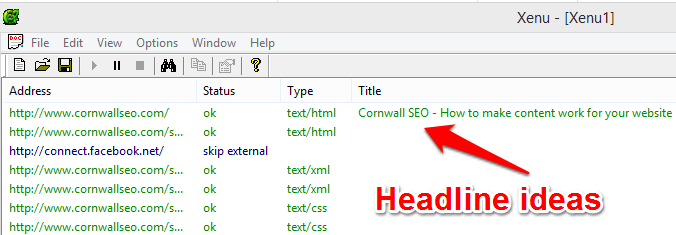
It works incredibly fast and is of course multi-threaded. It is an excellent tool for quickly pulling out great headline and content ideas from competitor websites, as it lists the Title of the webpage.
You can easily export the results to an Excel spreadsheet for further curation.
Screaming Frog
The new kid on the block, although it’s been running for a few years now, is Screaming Frog. The first thing to say about this tool is that it has been specifically designed for the SEO and so has all the elements that was sorely missed from Xenu, the only small downside is that the Premium version is £99 per year, although there is a free version which can give you 500 results and has all the functionality apart from being able to save of export.
If you are a professional SEO this has to be part of your toolbox, although I am told there are still old timers who resist holstering their Xenu.
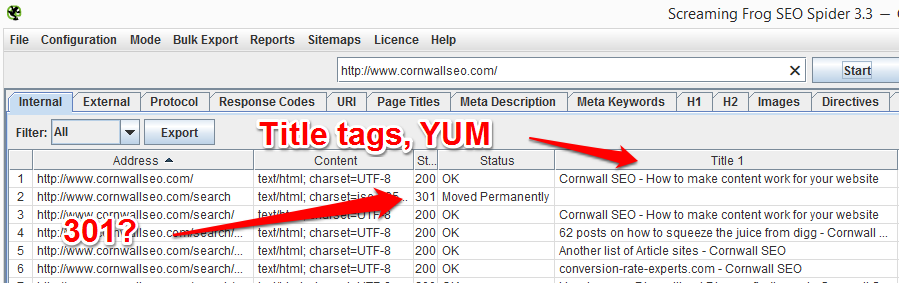
It reminds me I have never bothered with Meta tags? Do you?
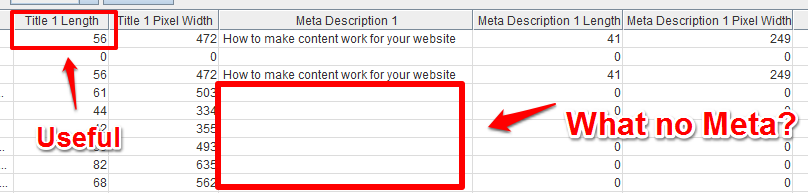
It is able to report a number of extremely useful stuff such as page load time, word count, outlinks.. etc.

Next Step
You need to crank up the Excel Spreadsheet, which is essential for a content audit. This will be the where everything is gathered and organised into separate sheets, with the ability to import various columns whilst using the URL as the key.
You can if you want go advanced and introduce MACROS, however that is beyond the scope of this simple, step by step guide.
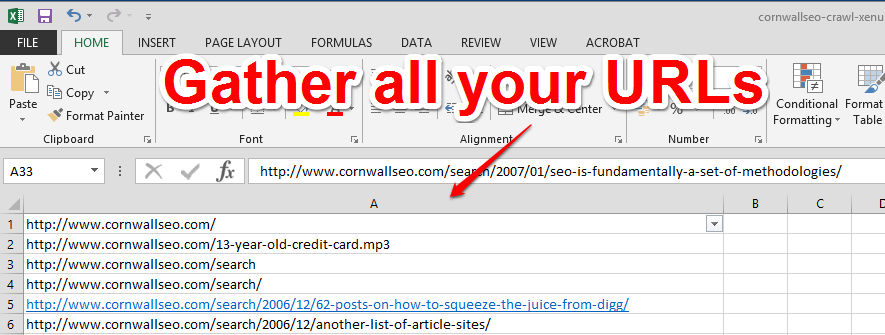
You may want to download an spreadsheet template so all the elements can be presented in a more logical way. The best one is from maadmob.co.au.
Social Signals
There are many tools available to index and collate the social signals of a website. This is now an essential part of the content audit as it reveals which content works well with the crowd. It is not a definitive indicator of whether or not the crowd does not like the content, as the content may not been have promoted properly. You can have the best content in the world, but if it is not promoted amongst social tribes, it is worthless.
But the audit can reveal what does work. This is crucial information and can shape your content strategy. Sometimes an audit can reveal hidden gems and give ideas of what future content to create, allowing you to increase the ROI of the marketing spend.
Which leads us to our next tool.
cognitiveSEO Social Visibility Tool
One of the tabs in your cognitiveSEO dashboard is the Social Visibility tool. This is an excellent way to see how the site is doing in the main social platforms of Twitter, Facebook and G+.
First thing it gives is a useful snapshot of the status of the social signal overall.
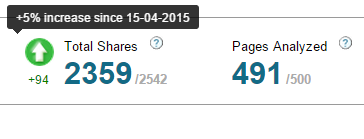
Here we can quickly see that the site has had an increase of +5% over the past 7 days. Where the Social Visibility Tool is really useful is the ability to track the social signals over time. This enables you to track the impact of specific content and promotions.
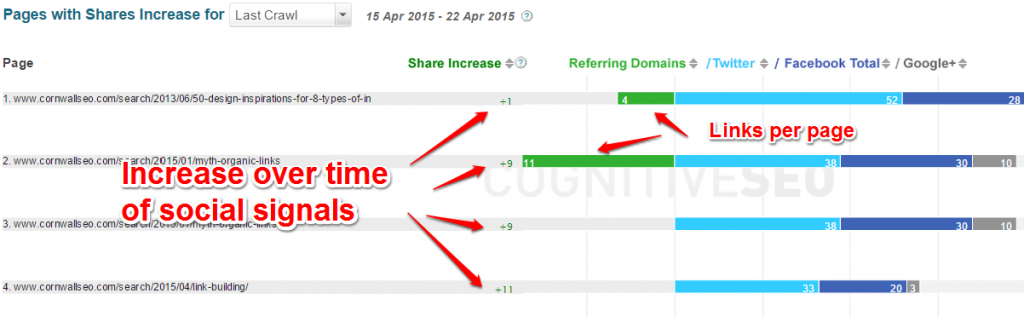
From the point of view of the content audit, the velocity of the social signals of a web page is probably one of the most important signals as it comes from the crowd.
Social signals for all pages are detailed in the “Most Shared Pages” section.
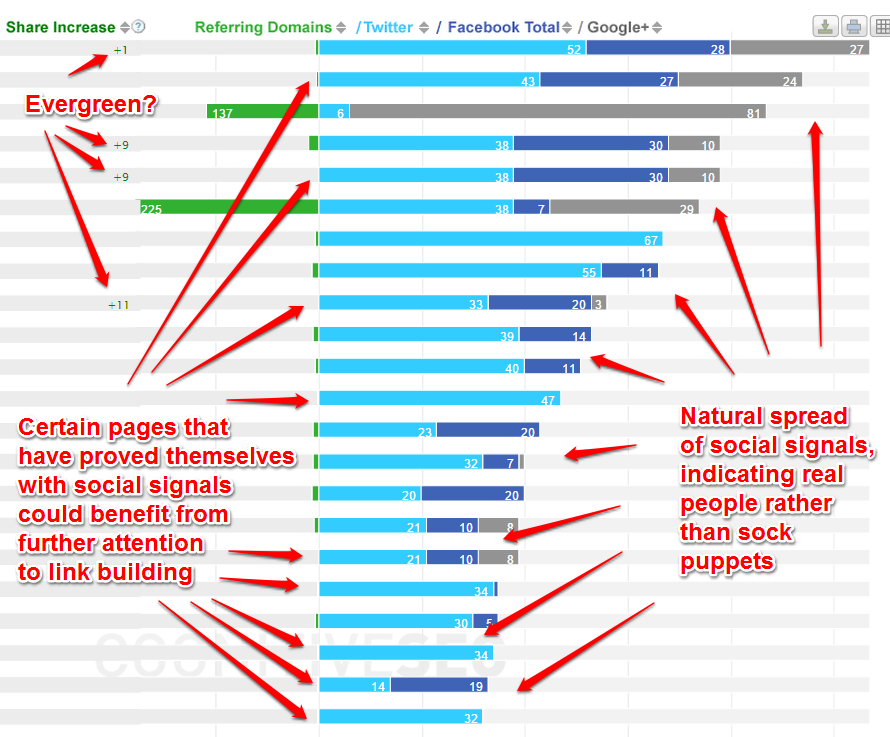
This gives even more data, all which can be downloaded and added to our Excel spreadsheet.
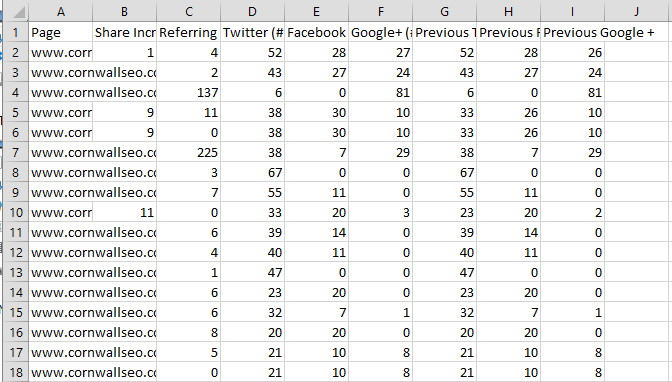
Obviously you can soon be drowning in data, and depending on what your focus of your content audit is will determine what importance you will place on each bit of data. But what is crucial is that you organise and sort in a way that enables you to see what the data is telling you and to be able to analyse quickly, and simply.
What About Links
Although we can get backlink data from the social visibility tool we really need to run a complete backlink analysis. This is the most powerful part of the tool and as you may already be well aware of what it can do I will skip over the detail of the analysis.
We need to know
- Which pages have links
- Where the links are coming from
- How powerful are the links in the eyes of Google

By correlating data we have gathered with the backlink data, it can indicate certain interesting aspects, such as:
- Do specific subjects get more links?
- Are certain promotion techniques better than others at getting links?
- Are social signals referring us to content which can get more links?
- Are certain content types more popular with social and link building?
- What content should we be concentrating in the future?
Conclusion
Everyone will have their own method of performing a content audit and you should develop the method which works for you. The work flow is just as important as the tools you use and having a methodology and a process is crucial to enable the results are reached in an efficient and speedily manner.
The conclusions of the analysis of the audit is shaped by what the purpose of the audit was in the first place, so make sure you have defined reasons for performing one.
If you are doing an audit for the first time, do not be intimidated but the data, there will be a lot gathered that will be useless to you. Concentrate of a few metrics and make sure these are gathered and presented in a logical clear format.
I would be interested to hear how you perform your own audits.






That’s it? Bit disappointed after reading all above stuff. I would like to see some advance stuff here.
This is just about data collection. I couldn’t find anything on how to do content audit? How to find strength and weakness of content from specific page?
Completely agree with you, there are lots of website owners who are sitting on the top of a heap of content but there is no traffic coming there way, lots of them attribute it to bad SEO, though largely true but they never do a serious audit.
@ FaiM, sorry it didn’t hit the spot, most people are not doing the beginner stuff or even attempting to do an audit and so starting at this point makes perfect sense.
We absolutely can do more advanced stuff in the future, do you have any niches or even websites you would like me to look at?
Also, I disagree that I haven’t looked at the strengths and weaknesses part of the audit. I have detailed how to look at links, tweets, facebook likes, G+ signals. I have not taken apart specific content, but that is not the purpose of this post. I am outlining the steps to take.
There are other blog posts I have written here that focus on specific content such as
https://cognitiveseo.com/blog/8201/content-ideas-performing-content-audit-digital-camera-e-commerce-websites/
https://cognitiveseo.com/blog/8250/getting-content-ideas-forex-niche-backing-analysis/
https://cognitiveseo.com/blog/7983/shopping-comparison-sites-use-tribal-content-boost-brand-marketing/
Plus a lot more, I suggest you make yourself a hot cup of Joe, sit back and digest it all.
@Cathy, and that technique used to work, to soak up the low hanging fruit in the form of keywords. Even yesterday .Inc had an interesting article about the changing scene of SEO, http://www.inc.com/adam-heitzman/the-new-age-of-seo-why-your-approach-must-change.html
Most sites that have been built over the past ten years have huge vaults of content gathering dust. Sometimes you don’t even have to create new content as you have enough already, but it’s not doing anything.
Topicality though, is very powerful and most people want up to date stuff.
Also the connection the reader has with the brand is becoming more powerful. People need to trust the information they read online and wish to give their money to people they like.
This is all about the new relationships between tribes and brands, which I have written a lot about.