
 Site Explorer
 Keyword tool
 Google Algorithm Changes


As we hope you already got used to, we, at cognitiveSEO, devote a large part of our time to improving our tool and therefore, to our customer satisfaction. We do believe that excellence is the gradual result of always striving to do better and that’s exactly what we are trying to do: a cutting edge product, tailored to our users’ needs and which provides highly accurate data.
And to prove that “cutting-edge” is not just a saying for us but really a constant concern of reaching the highest level of development, we are more than pleased to introduce our latest improvement:
Artificial Intelligence!
That’s right! We are making cognitiveSEO smarter and this is not the plot of a Science Fiction movie. We are now in 2015 and the question of whether a system, a computer or an app can think is no more interesting than the question of whether a submarine can swim. As the computer scientist John McCarthy, who coined the term in 1955 said, artificial intelligence is “the science and engineering of making intelligent machines”.
Quantum Leap in Unnatural Link Detection
Classifying a link quicker and more accurately is a key interest that a lot of the people working in the digital marketing field have. This is why we created the Automatic Unnatural Link Detection. It’s an easy to use tool for a complex problem, allowing real-time analytic and complex decisions to be automated. Meaning that you don’t have to spend hours and hours of working and go blindly to the lawn of thousands of links trying to classify them correctly,but just run all of them in the cognitiveSEO platform and the system will do all the work for you.
Yet, like most of the systems, this classifying algorithm also works on pre-defined rules. And this is great as we took the performance up to 97% percent well-done classifications and a false positive ratio of only 3% on our testing dataset. Yet, as we know that striving and struggle precede success, even in the dictionary, we wanted to do even better than that. As the digital marketing world is an ever-changing carousel, we felt the need of a new imperative alongside this accurate real-time system: self-learning and self-evolving system.
The question that kept us awake for many nights was: is there a way we could develop an algorithm that can adapt to the current digital marketing conditions on an ongoing basis?
The industry evolves so quickly that the rules designed to perfectly classify a link today might be quickly out of date by tomorrow. And after many sleepless nights and working hours we put together an adaptive system whose operation algorithm is worked out and improved by a self learning process.
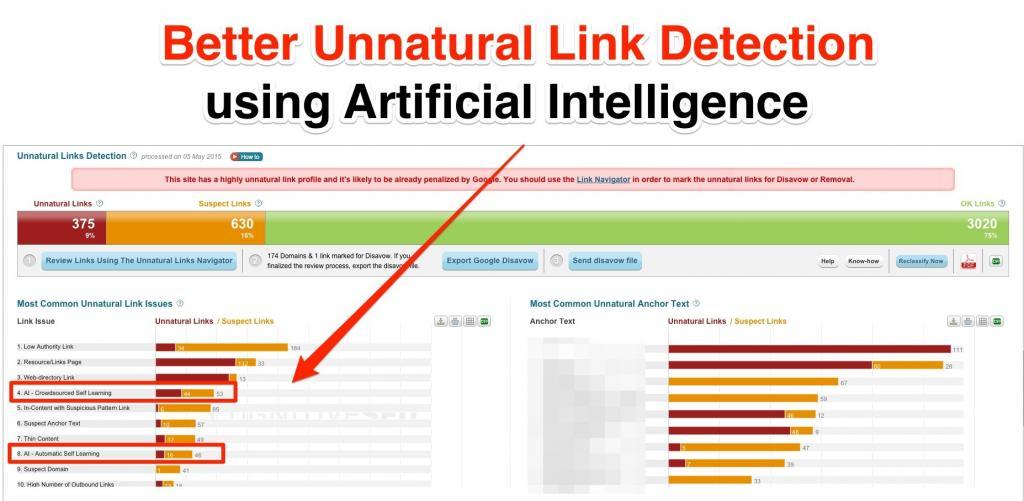
The SEO world has changed and there is no need of saying this one more time. Yet, as much as it would change lately, a constant burden remains: the unnatural links and the penalties they draw.
What would you say about a system that not only classifies your link profile after highly accurate rules, but a system that also learns along the way and makes an even more precise analysis of the links based on its own previous experience and human crowd-sourcing.
Alongside with the other rules used for the unnatural link detection, we created two more rules, artificial intelligence based: Crowdsourced Self Learning and Automatic Self Learning.
Let’s take a closer look at each of them to better understand how they’re working.
AI – Automatic Self Learning
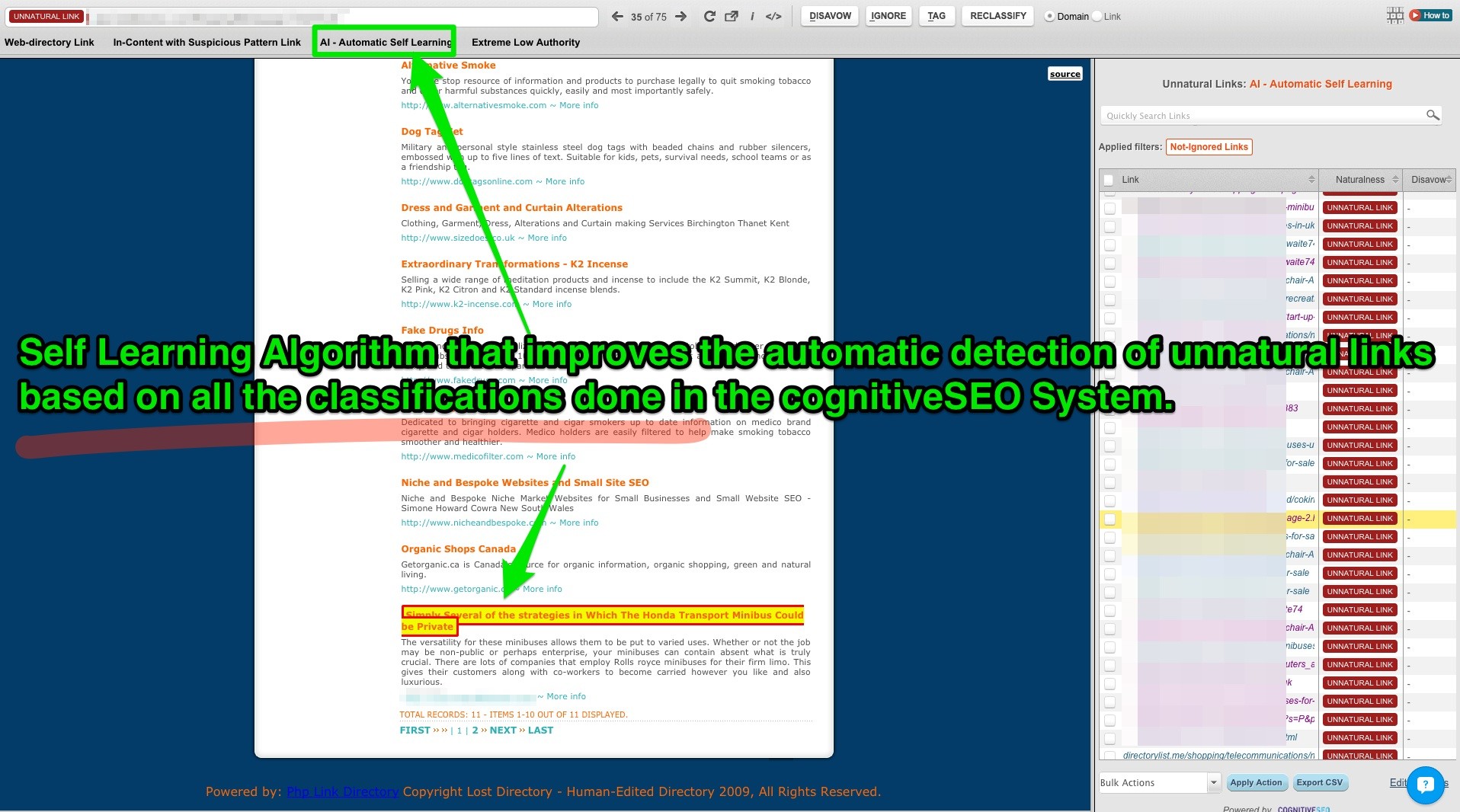
The self learning algorithm, as the name itself says, automatically detects unnatural links that appear on a wide range of sites. That’s right! The system is learning from the past analysis that were done meaning the more you and other people are using it, the more accurate the results will be. Let’s take online ads for instance. Everyday you are probably overwhelmed with all sort of online banners that advertise all sort of things that interest you or interested you at some point. Remember how the online advertising world used to look a couple of years ago? Not -personalized at all. It didn’t matter if you were a young high school graduate looking for a job, you were provided with expensive cars ads or discounts on baby clothes. Nowadays, things look totally different. And so does our system. It learns about each and every user and provides him with an even better link classification. And for the system to be a better “student” it needs as many “teachers” with different background as it can get, in order to learn form all and provide the best results it can.
The Automatic Self Learning Algorithm improves the detection of unnatural links based on all the classifications done in the cognitiveSEO System.
AI – Crowd-sourced Self Learning
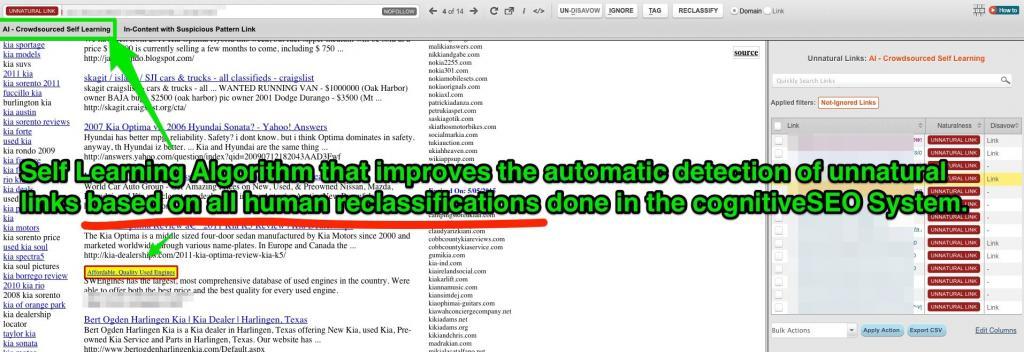
A self-learning system may spot really complex patterns, but even so, these need to be validated before any action is taken. Algorithms are still not as smart as experienced humans and there’s currently no substitute for human intuition. But what if there were an algorithm that could constantly learn from its users ? Daily, in the cognitiveSEO system thousands of links are being reclassified by our users. Therefore, in order to improve our results, we decided to take all these re-classifications, record them and feed them back into the self-learning system in order to improve its performance. And this is how we created a new rule of our self -learning algorithm, one that relies on the interaction of our users and learns from the irreplaceable human action.
The Crowd-sourced Self Learning Algorithm improves the automatic detection of unnatural links based on all human re-classifications done in the cognitiveSEO System.
Unnatural Link Detection Improvement
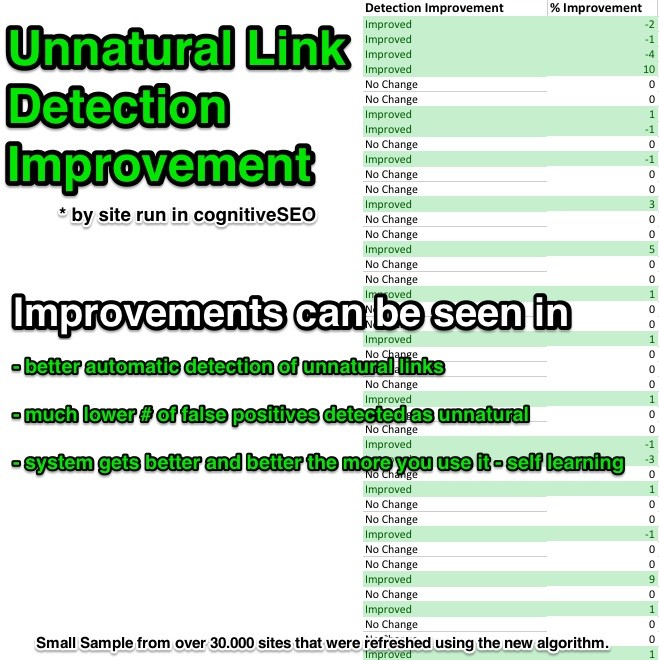
Don’t think that we added these new rules without being 100% sure that they bring added value to our tool and improve our user’s work, results and overall experience with the tool. Therefore, we’ve run all sort of tests in order to see the self-learning algorithm’s main improvements. We run the system on around 30.000 sites using the Artificial Intelligence Unnatural Link Detection. We saw some great gains that convinced us that the time invested on the research of these new rules was the best time we could spend.
We already had a very low false positive ratio of only 3%. Yet, the new enhanced system lowers it even more!
Furthermore, the overall automatic classification of links was better and we saw some improvements in identifying with greater precision the unnatural and OK links, proof that the self-learning system is doing it’s job correctly. As the system learns from you, our user, the more you use it, the better it will get and of better help it will be for you. At the end of the day, it’s a “help me help you” cycle.
The idea of designing a self-improving systems has long been on our mind. We wanted to turn cognitiveSEO into a software application that learns to reconfigure and adapt itself to new and changing inputs that the digital market world offers.By developing these automatic and adaptive algorithms we think that we have greatly improved the efficiency with which our users can make informed decisions in every phase of their link audit and strategy creation. Yet, there is no substitute for human input but if things evolve in this direction,the human actor will evolve to be just the “validator” of the artificial intelligence strategies.
Looking forward to see how you think the new algorithms work. Please share your opinion in the comments!






Great leap forward for unnatural link detection!
Really excited to learn that cognitive SEO is now incorporating AI + crowd sourced machine learning into its algorithms.
stay tuned for more 😉
Good to see AI and “machine learning” applied to the link quality analysis problem.
doing our best 😉
Seems a good move because unnatural link detection is a priority worry in webmaster’s mind..good to see cognitive taking such steps ahead than other popular tools in the market, will give it a trial soon to check myself
the algorithm is already seeing automatic improvements and the users are sending weekly confirmations that the upgrade has really improved the detection.
Great job guys, good to see things are moving in the right direction regarding the low quality identification.
As mentioned a while ago, I still feel you are missing a trick by not allowing users to upload the disavow file to automatically disavow a large number of websites instead of having to manually do it all over again. I’ve noticed Ahrefs have just added this to their website so it is clearly worthwhile. 🙂
tks for the feedback Adam. we do allow you to import Disavowed links. You need to simly ignore them. So basically you import the list of links you need to ignore and the system will do just that. Ignore the links from your Inbound Link Analysis. Here is more on this http://support.cognitiveseo.com/knowledgebase/inbound-link-analysis/#ignore
For some reason I didn’t actually receive an update on this comment so that’s my bad. I see what you are trying to suggest, but the problem is all you are doing is ignoring the links which means they won’t be included in the revised disavow file.
My suggestion is that when you are able to upload a disavow file which will then automatically tag all of the domains with disavow so we don’t have to go through the list again and redisavow them. This makes it easier for coming back to the campaign in future and making any alterations.
tks for the feedback Adam. we are surely looking into that 😉