
 Site Explorer
 Keyword tool
 Google Algorithm Changes


We can already notice a convergence between digital marketers, SEOs and webmasters. Nowadays they all have their tasks and responsibilities, yet all of their work will revolve, more or less, around the concept of link building. This is the topic that we’re going to talk about in today’s article.
The concept of link building represents a way of creating a high authority website, with a great page rank that will ultimately lead to achieving your company’s marketing goals. To make it clearer, it’s the process of getting external pages to link back to your own website. By using the correct and most successful techniques you will be able to build a strong brand in the online environment, get links for better results in the SERPs and gain more relevant visits to your website.
In this article we’ll tackle each step of the link building process. We’ll make sure to mention and explain the factors you should keep in mind and what you should try to avoid when starting on the link building journey. Another topic that we’re going to touch on in today’s article is the social aspect of link building. It’s already 2015, we believe it’s past time to stop thinking the way search engines view your website and start thinking about how people view it. Digital marketers shouldn’t want links for the purpose of ranking higher in the SERPs, they should want links, shares and mentions because they did something worthy, something real that people found it to be worth sharing. The higher ranks in the search engines will come as a result of this, the algorithms are already advanced enough to notice when people are speaking about you.
The Link Building Process
There are countless guides, tips and “top five ways to build links” articles out there, but we’re going to take a more technical approach to the subject. We’re not saying those articles are bad; we just want to make sure that, when you get into the link building process, you do it the correct way, since we all know what happens when you get bad and harmful links pointing to your website.
We believe that in 2015, when planning the link building process, you should go through the following stages:
- Preparation
- Strategy
- Quick Wins
- Content
- Prospects
- Networking
- Promotion
- Report, Debrief & Repeat
We’re about to go in-depth through each of these steps after taking a look at the guiding principles that all link building should take note of.
Penalties to Look out For
In order to start the link building process you need first to know the rules, the lines that you shouldn’t cross, which basically translates to “What can I do in order to avoid Google Penalties?”. Whatever your goals for the link building efforts may be, you must stick to the guidelines in order not to shoot yourself in the foot with your actions.
Let’s get to know the penalties that you will be trying to avoid in your link building actions.
Manual penalties
The first type of penalty you want to avoid is Google’s manual penalty. As the name suggests, this kind of penalty refers to actions taken by Google employees who personally go through your website, review it and penalize it. You will encounter this situation if Google believes that you may have deployed some shady tactics in your link building actions. Dealing with this kind of penalties takes a lot of work but it can be done. Our advice would be to stay clear of any shady tactic and read up on the guidelines.
Algorithmic penalties
The second type of penalties are the algorithmic ones. These are the penalties received from the Penguin or the Panda updates and, as the name suggests, are automatically applied to your website if the Googlebot detects an unhealthy link profile, duplicated content on the pages and other shady behavior on your website. Google is constantly updating the algorithms in order to minimize the involvement of human reviewers.
The biggest difference between these two types of warning is that you will not receive any message or email from Google when your site is affected by an algorithmic penalty. You’ll just see your rankings drop into the void. There are also ways to recover from a Penguin penalty, but again it takes time and effort so we suggest you should avoid any shady action in your link building process.
Main Guiding Principles
Before we get into the action let’s go over some guiding principles that we’re going to pay attention to when starting the link building process.
Never Get Unnatural Links. Always Aim for Building Good, Natural and High Quality Links.
Let’s go through an example by using the cognitiveSEO tool to check the aftermath of a link building process. The tool automatically classifies the links gained into three separate categories: unnatural links (the ones that will draw the wrath of Google), suspicious links (the ones that may raise a few flags) and OK links (the good ones).
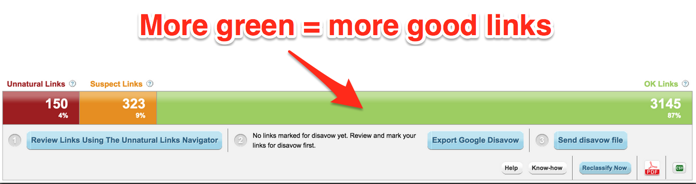
bove you have a somewhat good link profile. The vast majority of links (87%) are awesome, but still there are some bad ones. The thing to get from this link profile is the fact that if you have this many good links, you can get away with a couple of shady links. We don’t advise you to do black hat techniques if you have a lot of good links, but you should feel safe with some gray ones (though you should check each one of them to make sure they are not actually unnatural), the suspicious ones. You should still get rid of the unnatural links since they may bring penalties, no matter what percentage of unnatural links you have.
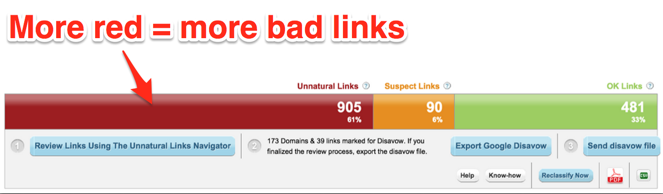
Now the example above is what you don’t want to see after you’ve done some link building. In this situation all your efforts have been in vain and you just gave yourself a lot of work to remove the links you have gained. You should pay close attention to unnatural links, especially in the early stages when you have few overall links.
Always Llook at the “Brand” value first. Ranking value is a by-product when you talk about the acquisition of a link! Don’t Make “Rich” Anchor Text Links!
What we suggest when starting a link building campaign is to focus more on the brand terms and not on commercial terms. They might trigger a penalty.

Even if you want to rank for that keyword, it’s best to have in the anchor text your brand’s name. We’re not saying that you shouldn’t get any keyword rich anchor text, but keep track of the balance between brand anchors and commercial anchors. If you have the majority of anchors pointing to your website in commercial terms, it could very well raise some red flags at Google.
We know what you’re trying to do with link building, you know it and you can be sure Google knows SEOs are trying to influence its search engine. Building links should be natural, a reward for great content or a great product, not some guy spamming comments to various websites. Keep that in mind when starting such a process, don’t make links that are clearly unnatural, “build” them as if people found value in what you do and want to spread the word.
When calculating risk, you weigh in the benefits vs. the harm. Well in this case let us be as clear as we can be, the harm of building low quality, unnatural links is immensely bigger than the reward. Not to mention the fact that Google’s algorithms get better each day. It’s just not worth it to do black hat link building. If however you do build some gray hat links, do it wisely. Google is a pattern recognition machine, so don’t leave a pattern in your links that matches those of spam sites. Get only small amounts of links from easy-to-build neighborhoods.
Less manual link building!
Don’t go around asking for links to your business. Even though it could be a great one, people are less likely to link back to you if you do that. Instead do cool things, write great content and people will share that. Present to potential link building prospects your own product, ask for reviews and if they find it ok or not, they might link back to you.
Always Monitor Your Links!
If that product review gets a link, and Google might see it as unnatural, then ask the reviewer to include a nofollow tag on it. By monitoring your links you can notice if you get a wave of bad links that could indicate that you are the target of a negative SEO attack. By noticing it you can easily disavow those links and rid yourself of a potential Google penalty.
Target Links from Sites and Articles Relevant to Yours. The same semantic category of content means a lot nowadays.
You will surely agree with us that it’s rather shady if you’re in a US car insurance business and the majority of your backlinks come from a cooking magazine, from Sweden. Those links are toxic. Now, even if you’ve bought some advertising space on that magazine, those links don’t help you all and they may even raise some flags over at Google and may get you penalized in the future. When building links, focus mainly on your business, and build links in the country that you are targeting.
Step 1. Preparation
So we went over through the guiding principles of link building and now it’s time to get to business. And that word, business, is exactly how companies should view link building. The process is not something that some guy over in IT can easily do once a month. It has to be well thought out and the campaign needs sound business practices including budgeting, good relations between all people and departments involved and agreed monitoring metrics in place, before the process starts.
Agree Upon Concepts, Budgets and Reporting Metrics
The main idea you should get from the first step in the link building process is what your client does, what your business wants. As an SEO you need to sit down with your client, boss or colleague and go over the definitions of what a link represents, if the social mentions and discussions can be counted toward links. Talk about the nofollow links and how they might influence search rankings. Get to know all that and have your client understand the concepts that you’ll be working with.
After going through the concepts and the budget, the next step is to go over the metrics that will measure the success of your link building campaign. Define these metrics together with the client and agree on what you’ll report on, be it ranking improvements, number of links, number of very high quality links, social visibility and so on.
Step 2. Strategy
So, you’ve agreed on the metrics and the budget with your client, it’s time to start planning and strategize the next steps. And just as the greatest strategist wrote: “Strategy without tactics is the slowest route to victory. Tactics without strategy is the noise before defeat”, in order to achieve success you need a well established plan with a list of tactics.
That Plan Should Be Placed Within the Context of the Owning Company’s Goals and Any Historical and Existing Marketing and Sales Strategies.
Context for Your Link Building Strategy
Before going on with the strategy you need first to understand the context. Context in itself is very different for each company, for each industry and market. You will need to have answers for all of the following questions:
- What is the brand?
- What are you selling?
- Who’s it being sold to? What do they love and hate?
- Are there personas to represent target audiences?
- What are the big world goals of the company?
- How important is the website to those goals?
- What are the expectations of link building?
- Who are the decision makers?
- What’s the history of this company’s link building – what has/hasn’t worked, and why?
- Does the site have an existing Google penalty for bad links? If so, fix first.
- Do you know the company’s editorial calendar (online and offline)?
- What stakeholders do you need to work with (ie. other departments)?
- Find out what you need to know about internal company politics.
Only after you’ve answered all these questions you may proceed to building the strategy.
Create a Content Marketing Strategy
Make your content marketing strategy as in-depth as possible. This is the only way to ensure that when executing it, you won’t waste time on details such as “Who am I writing for”, “What do I want the reader to do after finishing my article”. You strategy should include:
- the topics to tackle
- the headlines for each article
- the frequency of posting
- the length of the articles
- the articles schedule
- inspiration and research sources
- call to action for each article
After you’ve finished the overall strategy it is time to move on to the tactics. We advise you use a broad range of tactics to achieve your strategic goals.
Step 3. Quick Wins
The next step in the link building process is the “quick wins”. These refer to quick and easy fixes to your website that can bring in a lot of results.
Broken Link Building
The fist quick win tactic we wish to present is fixing the broken links on your website. To find out exactly which links have 404’s you can use Google’s Webmaster Tools. Follow these steps:
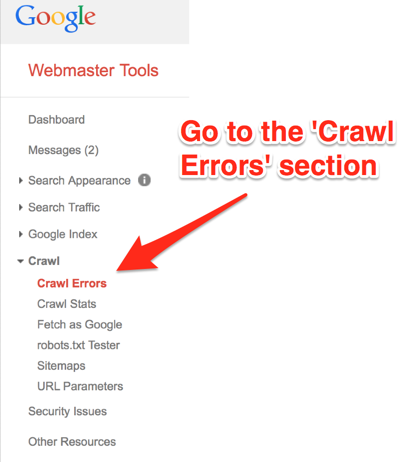
In the Google Webmaster Tools dashboard go to the Crawl Errors section of your website to check for any 404 errors on your website.
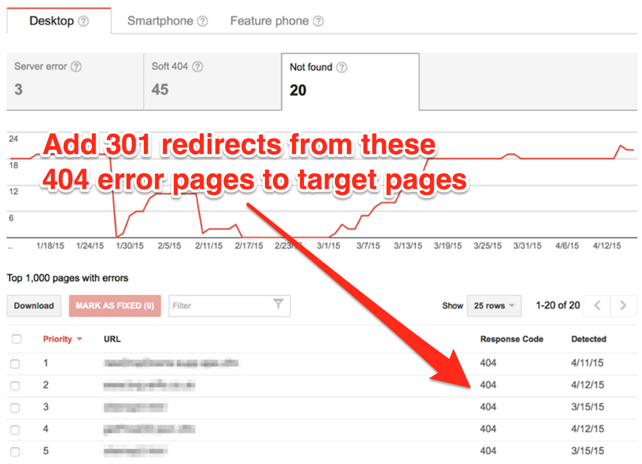
You’re now presented with a list of all of the 404 errors that Google crawlers have found on your site. The next step of this quick win is to add 301 redirects from these 404 error pages to pages that you wish your visitors to go to. To see exactly who is linking to the broken pages you can use the cognitiveSEO tool and check for each of the broken 404 pages.
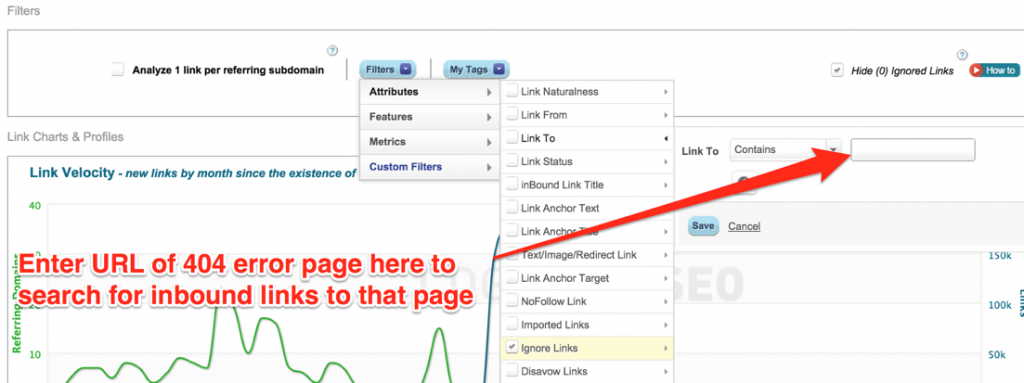
Now that you’ve found who is linking to your broken 404 pages, you can even send a message to the webmasters to fix their link and have them link wherever you wish. This is a great advantage for you, but also for the owner of the webmaster who has broken links. Usually they don’t even know about this situation and offering to fix this issue and replace their broken links with new ones should be hard to refuse.
Internal Link Building
Optimizing your own website is the key here. Make sure you review all the pages from your website and make sure that from each one you can get to any page which has a similar and related subject. You can use here relevant anchor text to link to the pages that can provide value to a user who’s on one of these pages. What we mean here is to keep the user behavior in mind and try to place links to any page on your website that users might be particularly interested in.
If your users see you as a Hub of Quality Content, the Search Engines will follow.
It doesn’t really matter if you are linking up and down or even across the site’s hierarchy. Make sure related and relevant pages are inter-linked and if your site is big enough to be organized into categories, a separate menu for each of them might help you out. Should you have a smaller website, linking from content can also provide great help to both the user and the search engine.
Remember that wherever the pages are in your site’s hierarchy, you’ll need to present your most important pages on your home page. Take a look at how Tripadvisor does this on the image below:

As you can see, from Tripadvisor’s home page you’re able to quickly access its most important pages. By linking them this way, lots of link power from your homepage is transferred to the deep pages of your website.
Turn Mentions into Links
Another quick and easy win to gain some great links is to be on the lookout for your brand mentions on the internet. To do this simply do a search on Google for your brand and analyze what you get:
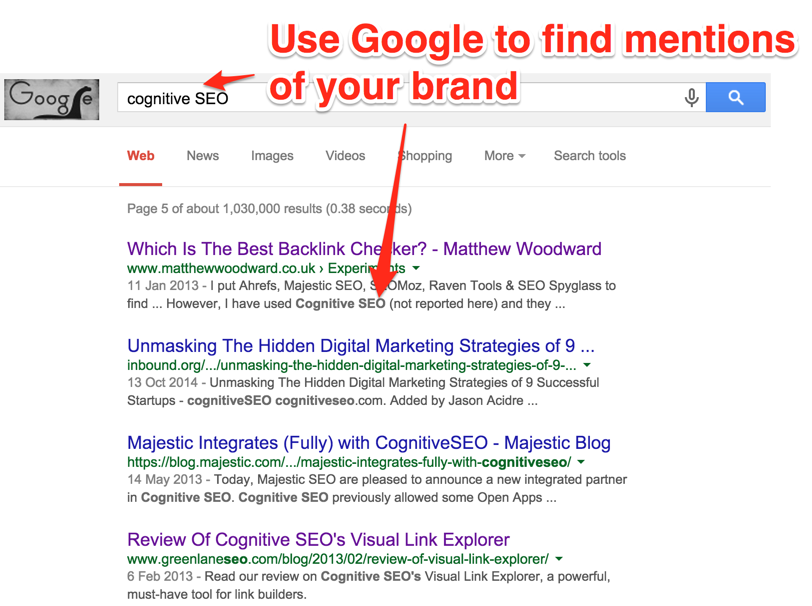
Check out each of the websites that appear in the search engines for your brand and see if they point back to you.

Just go ahead and contact the webmaster or the author of the articles that mention your brand and ask them nicely to add a link to one of the mentions of your brand. There is a high chance that they will do so, since they are already interested in your product or business to talk about.
In order not to search Google for your brand constantly, we recommend you create a Google Alert for your brand (in case you don’t have one already, which you should) and get notified instantly when you brand is mentioned. If it’s mentioned, ask the author to include a link in the articles.
Step 4. Content
Now that we went through the quick and easy gains of link building, it’s time to get to the hard stuff. The content in itself is where most of your focus should be directed to.
Create Content for Influencers and Existing Customers
Links can be gained from both influencers as well as from your existing customers. If you make great content we assure you that there is a much higher chance that they will share it and even link to it. They are one of the targets of your content marketing strategy. When you write make sure to have the overall strategy in mind and have your strategy include what your influencers as well as your existing customers are sharing and tweeting. This way you can adapt your content to their preferences. Find out what makes your audience tick. This way you can make sure your content contains the best baits and hooks to draw in audience attention.
One of the simple ways to find topics that create the most emotional response is to invest time on forums, Facebook pages and read blog posts and see which kind of content gets the most traction. Let us give you an example and say that you’re targeting Chelsea FC fans. You go to one of their unofficial forums and take a look at what gets the most attention (now write about Jose Murinho and Eden Hazard).

This example says it all. You go in, check for what’s “hot” with your audience and immediately start producing content that will be of interest. If your content and opinions are great, you will probably be receiving links from them.
Integrate Online and Offline Campaigns
Make sure you build online hubs for every offline campaign. Especially in the case of events, where many people are invited, gathering them in an online hub on your website or on a social media site could provide some great linking opportunities. If you heavily promote the campaign in the online world, make contests and start engaging users, they will link to it and you’ll build some great natural links this way.
Create a Variety of Content *Types*
Content doesn’t refer only to blog articles.
Sure, they are the backbone of a well structured content marketing strategy but there are so many ways to do it. Surprise your audience once in a while and produce an infographic. This type of content gets often shared, and it can be easily linked back to your business. Or better yet start writing e-books for your audience.
Depending on the industry you’re in, make sure you take in consideration video content too.
It has such a great potential in almost any market. Even though it is more expensive to produce it could provide amazing results.
Make Sure You Don’t Get Stuck with Blog Content as a Content Marketing Strategy. Start to Include Ebooks, Webinars, Press Releases, Podcasts and Video Content in Your Content Strategy too.
Surveys
We’ve even talked about surveys on our blog recently. They are a great way to get tons of ideas, better understand your users and get tons of data from them. You can create surverys really easy with tools such as Survey Monkey or services as Reserchnow . Emphatic or unexpected survey answers can inspire interesting articles that are worth promoting to “big media” publishers (such as infographics).
Let’s take the forza supplements survey as an example.

They first ran a survey for research purposes on their site. Following the success of the research and the traction this is what happened:

Tons of links from high authority websites pointing back to the survey. Now depending on your industry and market, make sure you’re able to produce these types of survey. If you do it well, the reward for such content is big.
User Generated Content
Getting your users to actively engage with your brand in such a way that it makes then want to generate content for your brand is an art. It’s such a difficult thing to do, that the majority of businesses simply don’t even bother to focus on it. Well that’s not necessarily true. Let’s say that you have a small cooking website, a simple way to build up user generated content is to make a contest and ask them to post their own recipes on your website or on social media. We find that contests work best here, they are really easy to come up with, only require resources for prizes and the community can promote the contest among themselves.
You can incentivize this with a giveaway if you don’t make a contest. Lets take Starbucks for example.

From the Starbucks’ example we can learn that it doesn’t have to be some great over the top contest, it just a simple idea, that doesn’t require a lot of work from the community that yields great results and in the end will get many links.
Create ‘How-to’ Videos
How-to videos seem to be on the wave right now. They’re somewhat easy to produce, depending on your industry, and provide great linking and social share potential.
To get some ideas on what to focus on lets use the Site Explorer tool to find the most linked pages:

Once you get the idea of what piece of written content gets a lot of traction, you can try to turn it into a “how-to” video. You already know that it can raise a lot of interest for your audience so you won’t take the risk that all the effort will go to waste.
Next way is to use Google’s auto complete feature to find out what people are searching for:

Google provides tons of great ideas for “how-to” videos. Use the autocomplete feature from Google as seen above.

Take a look at diy. We can see that the most popular videos are the ones that appeared in the autocomplete feature from Google. We can’t say for sure that this is the way they get ideas for content, but for their website it seems to work really well.
Make Quality Images Available Under CC License
A simple and effective way to get some links is to upload images to your company’s Flickr account and mark them available through CC license. This will get lots of links since the only requirement for using the images is linking back. Ford seems to be using this strategy really well. The company profile is filled with images, graphs and pictures of their cars that are used in different medias and are linking back to the company’s website.
Blog Reviews
Review great blogs and websites in your market. This will draw the attention of the big players in the industry and if your review is a positive one, in most cases they will link back to you.

In the example above, Dailymeal made a top of the best food blogs in 2014 and posted it on its website. Now tell me which blogger doesn’t want his name to appear in such a top and which of them wouldn’t want to link back to this top in order to show how great he is.
Product Reviews I – ‘Generic influencers’
These two next content types go hand in hand. The Generic Influencers product reviews refers to giving away your product, for free, to influencers in the industry. Depending on the product and industry they will usually write reviews about and link back to you. Influencers are looking for content that will be of interest to their user base. It’s tough to convince influencers to try youe product but here is where your “sales” tactics should come in handy.
Product Reviews II – ‘Experts’
The second type of product review is getting experts to review your business on your own website. Now with this content type you’re betting on links on the authority of the expert that writes the review. You’re betting that his authority will draw in the social attention that will be enough to get links from. In general, this kind of practice works best in auto industries, to get a celebrity to write a review of your product on your website will get a lot of people talking about it. You can even view it as an endorsement.
Re-purpose Existing Content
If you’ve been working on your content for some time, we’re pretty sure that you also have some old and great content that rarely sees the light of day. You can re-purpose the content in ways that it will bring additional value to your users. Creativity is always the key! Old content can be gathered up, cleaned up and promoted to your audience once again. You can easily make an e-book out of the content that has gathered over the years in your blog archive and promote it to your users.
Consider Every Possible Idea
Always try to improve and never settle for the same ideas. Even if they work and provide great results. We all know the saying “if it’s not broken, don’t fix it”, but in today’s world, what works today might not work tomorrow. This is why you always need to be constantly up to date with every new link building technique out there.

Even if you’ve done your research and worked in the same field for years, it’s still best to go over what’s new. There are a lot of sources out there from which you can learn, experts and people in the industry are always publishing and are trying to create conversations around the newest strategies. This way you can make sure that you’ll never be one step behind the industry and that your efforts are always up to date.
Step 5. Prospects
This part is done now. Now it’s time to move on to find the people and sites that should be outreached to in order to maximize your contents’ external linking.
Prioritize Link Prospects that Can Deliver Traffic, As Well As SEO Benefits
Always go for link prospects that have high authority and can bring in lots of traffic and SEO benefits. We’re not saying you should ignore the low authority domains but focus your efforts on the big fish. It’s likely that you’ll have to analyze the prospects with a Pro tool.
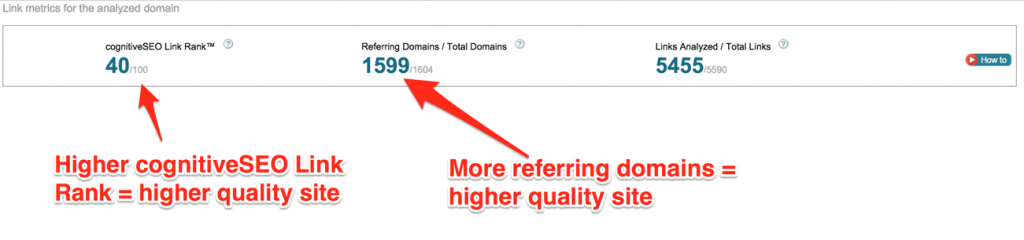
With a quick analysis we can already see that this prospect is one of those “big fish”. They have a good link rank and a large number of referring domains that are pointing to the website. This is what you should be looking for. Next up is to check the link velocity:
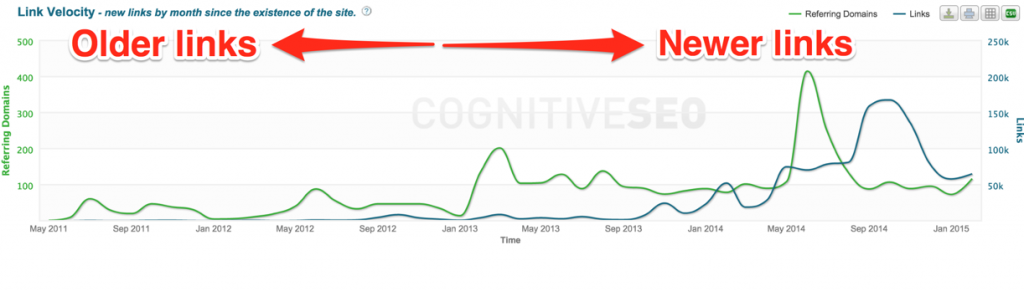
By studying the link velocity charts we can tell that this site is being worked on. Once you have data about the growth potential of the website you can add it in your outreach list. In the chart above we can see that the website has a good link growth with nothing too shady about it. Getting a link now on this website will probably be worth a lot more in the future.
Competitor Research
You’re probably already checking what your competitors are doing. So why not check where they are getting their links from?
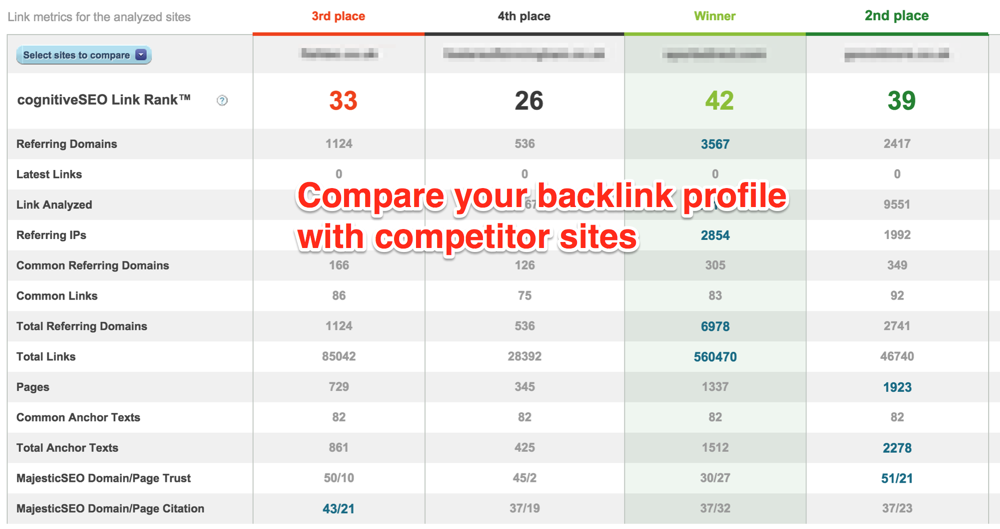
The cognitiveSEO competitive analysis allows you to benchmark your metrics to those of your competitors. But that’s not all it does. You can also check out you competitors links. By using the link intersection technique you’ll be able to find a lot of new link opportunities for your website.
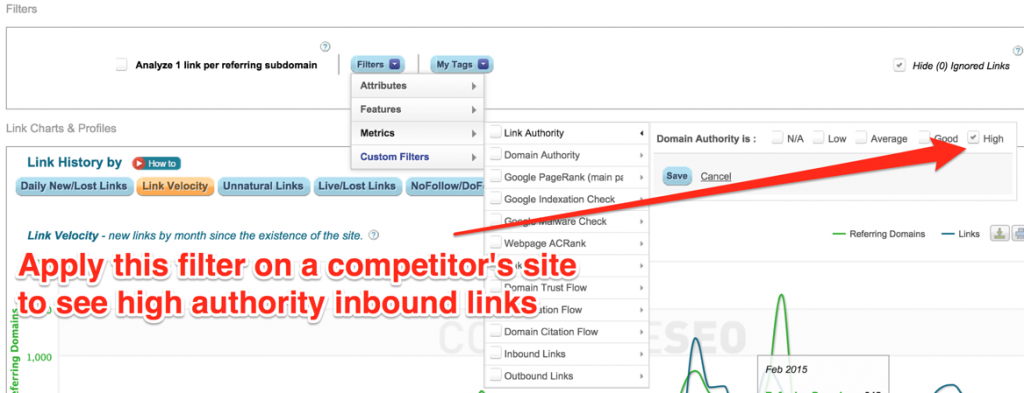
Once you apply the filters you should be left with only the high authority link prospects.
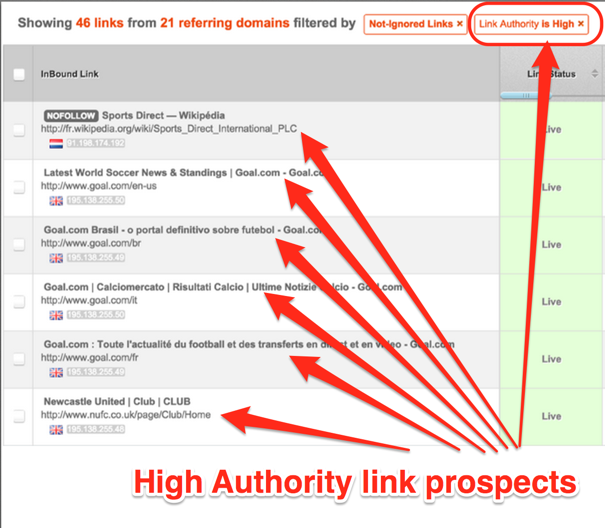
Above you have the filtered version displaying only the high authority link prospects. They are a great opportunity for your business to tackle. They are already linking to your competitors, meaning that they are somewhat interested in the business area you’re in. Once you contact them and present your product or your content, there is a high chance that they might mention you.
Broken Link Building II
Another way to find quality link prospects is to search for expired domains in your industry. By using the cognitiveSEO tool you can easily track and find links that are pointing to expired domains. Next step would be to try and contact the owners of the sites in order to fix the dead link issue. You can present them with another link (to your business) and tell them that broken links are hated by both users and Google alike. You will get some links this way.
Step 6. Networking
It’s all about building a community, a tribe around your business and market. In the age of the internet, time flies faster than in the offline world. If you are not communicating online for a week, or a month, people will forget that you even existed, so don’t let that happen.
Engage with your customers and with the influencers
Social media is a great way to speak to your customers. Have your company or your client set up accounts on all the major ones and with each piece of content that your produce, spread it out. Find out what works best for each social media platform and fine tune the content for the one that works best or for the one that you wish to tackle.
Targeting influencers is more in-depth topic that should be tacked separately. Basically you need to start and nurture a relationship with them in order to be able to even start to ask them for “favors”.
Online PR Mindset
When you engage in a link building process, you’re no longer an SEO or a marketer. You’re supposed to be all of it: webmaster, SEO, marketer, copywriter, PR specialist researcher and so on. Always pay attention to the industry news and get to understand the content that they publish. Reach out directly to the journalists and editors and offer them tailored content. If the content is great and if it offers value to their audience, it will be posted. Our advice is to be persistent and polite. Following up emails with phone calls is not something that you should shy away from.
Become an Industry Expert
People need reasons to listen to you. You can “scream” as loud as you can on the internet, but if people don’t see reasons, why they should hear from you, they won’t be bothered to look at what you’re saying. The only way to fix that is slow: step by step become an industry expert. And since you’re working in that industry already this will help you as much as it helps your business. So our advice is to become an expert, prove your knowledge through blog posts, user engagement, books and guest articles. Once you reach that level, you’ll find it a lot easier to reach your audience. Eventually others will come to you for quotes and ask for content from you, the links will also follow shortly.

HARO (Help A Reporter Out) offers a great service. You can use them in order to be get on the radar for the journalists that are looking for experts in specific areas of expertise. Moreover they could mention and quote your expertise in their own articles, getting really great and high quality articles.
Giveaways, Contests and Special Offers
Invite bloggers and other influencers to run contests and giveaways on their blogs with your top products. Everybody likes a contest and we’ve mentioned earlier that they have a lot of link potential.
You can use the rafflecopter platform for giveaways that require entrants to follow, like and share. With a simple giveaway you can get links, and a lot of social media attention.
Step 7. Promotion
There are two ways to engage is this action. And both of them are focused on social media.
Promote to Your Customer List
Each new piece of content should get announced to your audience. You’re not running a monologue website, you need people to talk back to you, to engage, share or challenge your ideas. Keep an email list of your readers and regularly email your content (with their permission). Use social media to promote your content and use their groups and circles to promote it to relevant users, the users that you want to promote your business to them.
Promote to Your Prospect List
The same goes for influencers. Emails, social activity are all welcome, but for them you need to go that extra step. You need to always have a conversation going on, help them out on their articles and even meet up with them at social events.
Step 8. Report & Debrief
We’re finally at the last step of the link building process. The one in which you check if all your efforts were successful or not. Now is the time to go over the notes you initially talked about with your boss or client and study the metrics that you’ve set out to follow.
Only by Constantly Monitoring Metrics You Can Improve Future Campaigns.
Conclusion
It looks like 2015 has a lot to offer to digital marketers. The link building process is getting more and more creative while Google tries to reward great content with higher rankings.
Always keep in mind Googles’ guidelines so that you won’t shoot yourself in the foot while trying to grow your business. We advise you to creatively build natural links and to try to create lots of conversation around your business. Google always finds the unnatural links and a penalty is the last thing you want to deal with when you try to grow your business.






Great job of breaking down the link building process and really defining exactly what it is! One detail I would like to see you elaborate on is the “Quick Wins.” Could you give some examples of quick wins? I may be missing something that could help my website without pouring in a lot of effort!
detailed you have 3 techniques:
Broken Link Building
Internal Link Building
Turning Mentions into Links
Those quick wins links are interesting. As George mention can you let us know what your thinking in there?
Thanks!
I think at the core of it (linkbuilding) all in 2015 is to ensure that wherever the links are built from, it is highly relevant to the site it is pointing to.
semantic related links are best