
 Site Explorer
 Keyword tool
 Google Algorithm Changes

SEO still keeps a lot of secrets for a lot of beginners out there, but even advanced users need to be constantly up to date with what happens in the online marketing world. We’ve put a together a list of eleven SEO facts you’ve probably never heard of before; however, even if you have, this is a friendly reminder.
From AI-powered search experiences to evolving ranking systems and user behavior, the industry never stands still. There are countless SEO facts, tips, and statistics floating around online, but not all of them provide meaningful insights. Our goal is to highlight surprising facts that can help you see search from a different perspective and rethink the way you approach optimization.
This isn’t another roundup of random SEO statistics or recycled advice. Instead, it’s a collection of insights that can help you think differently about search, improve your optimization strategy, and prepare for a future where visibility depends on more than rankings alone. Whether you’re optimizing for traditional search engines or AI-powered answer engines, these are the kinds of facts that can change the way you approach SEO.
- Duplicate Content Won’t Get You Penalized
- Algorithms Now Read Sentiment and Emotion
- Not All Search Engines Use Links as a Ranking Factor
- Top Ranking Positions Have Significantly More Facebook Activity
- Rich Snippets Have No Direct Impact on Your Rankings
- Only 2 of the Top 10 Most Popular Sites Are Content Sites
- Object Detection in Images is a Strong Ranking Signal
- Google Has Search Evaluators to Determine the Quality of Results
- A Video on Your Homepage Will Double the Chances to Show up on Page 1 of Google
- Travel Time Is a Metric for Google’s Ranking
- Google Ranks Events Based upon Popularity
1. Duplicate Content Won’t Get You Penalized
Will you be penalized for duplicate content? No. Is duplicate content hurting your site? Well, it depends. Allow us to elaborate more on this matter.
To start with, we will cite the Google Search Quality Evaluator Guidelines from September 2019 :
The Lowest rating is appropriate if all or almost all of the MC (main content) on the page is copied with little or no time, effort, expertise, manual curation, or added value for users. Such pages should be rated Lowest, even if the page assigns credit for the content to another source.
Did you see duplicate content mentioned anywhere? No. It’s all about copied content. And Google has a different treatment for copied content than for duplicate content. Duplicate content won’t get you penalized, while copied content will. If you don’t believe us, take a look at the video below where Andrey Lipattsev from Google claimed that:
There is no Google duplicate content penalty.
Duplicate content is not always hurting SEO as most of the people think. Of course, duplicate content is not an optimal set-up for pages. Nevertheless, most of the time duplicate content is not manipulative. If you use canonical tags to let search engines know the preferred content, you should be safe. What we want to stress on is that there are many users who have never gazed over what Google says about the duplicate content.
It is not called a penalty if Google notices that your content is not unique.
As Andrey Lipattsev, the Search Quality Senior Strategist at Google Ireland describes in the video mentioned above, you can notice that:
- Google does not have a duplicate penalty
- What it does is to reward unique content and correlate it with added value
- The duplicate content is filtered
- Google wants to find new content and duplicates slows the search engine down
- If you want Google to quickly discover your new content, you should send XML sitemaps
- What the big G wants us to do is to concentrate signals in canonical documents, and optimize those canonical pages so they are better for users.
- If we think about SEI, it is not duplicate content that is hurting our ranking, but the lack of unique content.
Remember that if there is a website duplicating your content and you do not have any agreement, you can fill in a request to have it removed under the Digital Millennium Copyright Act. Another thing that you can easily do is to use canonical tags. This is a simple way of telling the search engine that this is where the official version first appeared. You should keep count of the duplicate content issues, anytime you start shaping your content marketing strategies or you want to analyze your SEO rankings.
2. Algorithms Now Read Sentiment and Emotion
For years, SEO focused heavily on keywords, backlinks, and technical optimization. Today, AI-powered search systems are much better at understanding natural language, context, and relationships between entities. Rather than evaluating a page based solely on matching keywords, they can interpret the meaning behind content and the way brands are discussed across the web.
As a result, brand mentions and overall online reputation have become increasingly important.
Positive discussions, authoritative citations, and consistent messaging can strengthen a brand’s digital presence, while recurring negative narratives may influence how users, and potentially search systems, perceive that brand.
This is where brand monitoring plays a valuable role. By tracking conversations across news sites, blogs, forums, review platforms, and social media, marketers can identify emerging trends, measure sentiment, and respond proactively to reputation issues.
💡 Pro tip: Platforms such as BrandMentions help organizations monitor these discussions at scale.
Using AI-powered sentiment and emotion analysis, they provide insights into how audiences talk about a brand, making it easier to spot opportunities, address concerns, and build a stronger online presence in an era where context matters as much as keywords.
3. Not All Search Engines Use Links as a Ranking Factor
Is it possible to rank without links? The answer is yes.
Yandex, the biggest search engine in Russia is no longer taking into consideration links as a ranking factor. Before saying that what happens in Russia, stays in Russia, you need to know that Google might be heading in the same direction. The Russian commercial SERPs in Yandex and Google are some of the most spammed keywords, where black hat SEO techniques are used to quickly rank shady sites. Given the situation, Yandex said that their algorithm will be a “link-free” one. Will the other search engines follow?
Will Google remove links from their algorithm? It seems like Google wishes to rank websites based on facts instead of links. They even discussed on the idea of excluding backlinks from the Google algorithm.
We don’t have a version like that that is exposed to the public, but we have run experiments like that internally […] we’ve played around with the idea of turning off backlink relevance and, at least for now, backlink relevance still really helps in terms of making sure that we return the best, most relevant, most topical search results. – Matt Cutts, former Google representative
It seems like Google wishes to rank websites based on facts instead of links. This means that the trustworthiness of a domain might help it rise up rankings if Google measures quality by facts, instead of links, according to New Scientist.
4. Top Ranking Positions Have Significantly More Facebook Activity
There is a lot of mystery and buzz regarding the influence of shares, comments, likes, etc. on SEO in general. A question keeps popping out:
Are social signals a ranking factor?
The answer is not as simple as a “yes” or “no”. What we can tell you for sure as a result of an in-depth study published in a previous blog post on this matter is this:
While no causality can be inferred, more presence on Facebook is clearly associated with a higher rank on the search list.
There were some other correlations we’ve made between Google+ (which is depricated), Pinterest or LinkedIn and ranks and it seems that higher rankings are correlated with Facebook, Linkedin & Pinterest high shares altogether.; yet, the strongest correlation was between a high number of Facebook shares and better ranks.
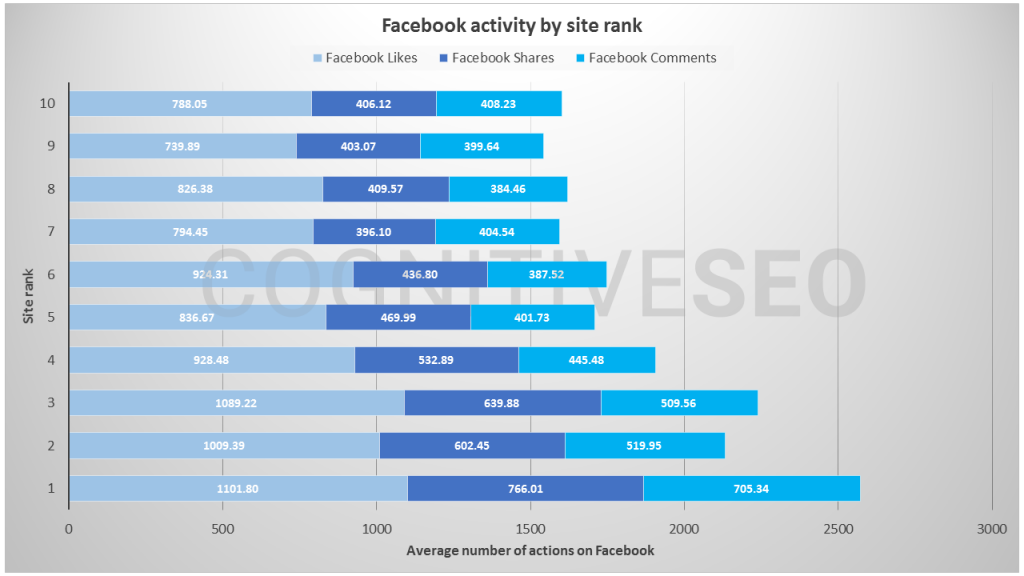
It’s true that correlation doesn’t mean causality but such a high correlation cannot be easily ignored.
It seems that Facebook interactions affect Google search rankings. Therefore, the social network not only provides engagement with your audience, but it also affects measurable outcomes beyond engagement, including higher search results ranking. You don’t have to be an SEO expert to know that organic listing doesn’t come up easily, regardless of the SEO tactics or social media strategy you’ve used. Yet, any little help that will improve your search traffic definitely helps.
5. Rich Snippets Have No Direct Impact on Your Rankings
Rich snippets have been a sneak preview on the SERP page since they first appeared in 2009. The question is: Do they have a direct impact on your ranks? Well, not really.
Rich snippets have the role of adding extra information to a search listing but, according to Google, they do not influence rankings. Google has stated several times that rich snippets have no direct impact on site rankings at the moment. You can even find answers on the Web Master Help Forum:
Q: Does using rich snippets affect my site’s ranking?
A: No.
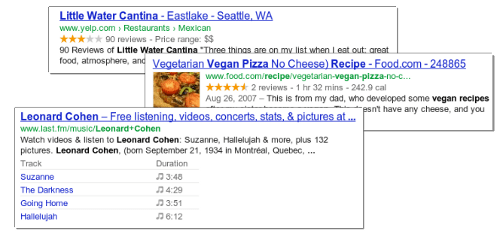
Source: www.seopressor.com
So Google said it all. Apparently, rich snippets do not affect our rankings in a direct way. This does not mean that it cannot generate indirect SEO benefits though, like helping a page to be easily indexable or showing useful data for the reader. Rich snippets will help you in an indirect way to get more people to visit your website, and that in turn might further help you with your rankings; yet rich snippets have no direct impact on your ranks.
6. Only 2 of the Top 10 Most Popular Sites on the Web Are Content Sites
In order to completely understand this let’s take a look at the 10 most popular sites according to Ebizma. It seems that the top most popular sites in September 2019 are: Google, Facebook, YouTube, Yahoo!, Amazon, Wikipedia, Twitter, Bing, eBay and MSN. No suprise here, I know. Yet, if we think of them for a moment we notice that only Wikipedia and YouTube are truly content-oriented websites. The other are “content gates” if we can say that but they are not offering direct content in a way a usual website does.
This leads to an important question:
Does usefulness matter more than content?
Eight of those sites give the core users something to do, not only to consume. As Carter Bowles from Northcutt claims, they do not stop at passive reading or video watching, but they give people tools and places that they can use to do something. These websites are popular because the action required from the core user does not stop at consuming content.
Google is a tool that gives users the chance of quickly searching the whole web in order to find something that they want. They are not popular due to content or fantastic link bait, but as a result of interaction. So, we might ask ourselves:
Is content still king?
We are not implying that content marketing is not working. Quality content is great because it provides an amazing way to grow. What we are stressing on is the fact that interaction seems to be working wonders. If we try to understand why these websites are popular, we will notice that up to a point, content marketing is also part of their strategy. But what facts prove to us is that the most outstanding sites out there place communities, tools and interactive platforms before content. Even more, those two content sites that are at the top of popularity, YouTube and Wikipedia, are still making use of interactive platforms.
7. Object Detection in Images Is a Strong Ranking Signal
You may know that Google is smart enough to recognize objects in images but what you might not know is that object recognition is now a ranking signal that can affect any business out there.
Not long ago we wrote an article about the way Google will read & rank images in the near future. Well, it seems like the future is now. It’s true that there have been lots of studies with complex equations and algorithms about image recognition since the ‘90s, so we can say that the subject has appealed to researchers ever since search engines appeared. What should be appealing for users is the idea of image optimization, and not in the classic way of adding title tags and alternate text.

Since the moment the big G made the Cloud Vision API public, a lot of people started raving about the technology. Without any doubt, Cloud Vision API can be used to analyze and determine what is inside an image. This quickly classifies images into thousands of categories (e.g., “sailboat”, “lion”, “Eiffel Tower”), detects individual objects and faces within images, and finds and reads printed words contained within images. You can build metadata on your image catalog, moderate offensive content, or enable new marketing scenarios through image sentiment analysis.
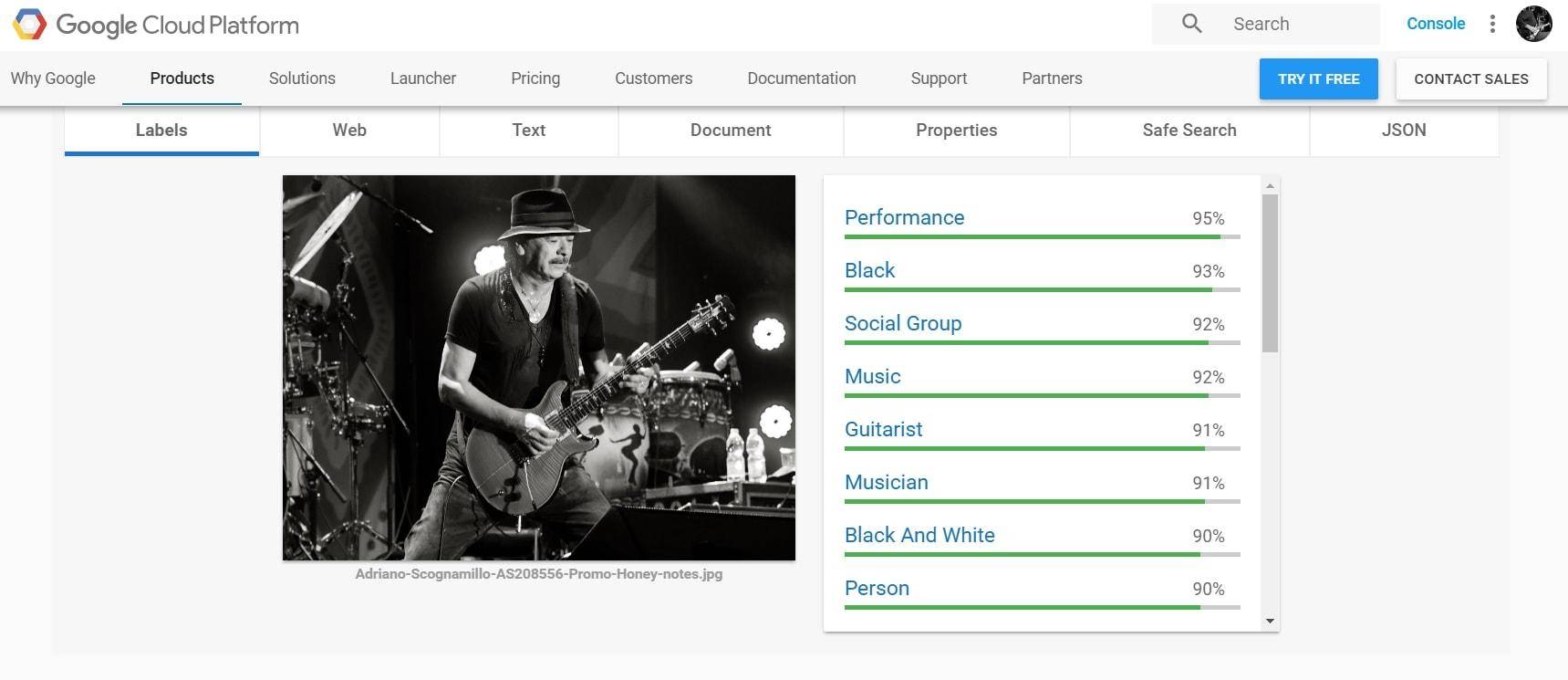
This feature allows search engines to detect what content is inside the images that you post on your websites and rank it accordingly.
Object Detection in Images adds an extra layer of ranking signals that cannot be easily altered.
However, this is really big for the SEO industry as the object recognition:
- Will help by helping Google to show a lower number of false positives when searching for a particular keyword.
- Can strengthen the ranking of a page
8. Google Has Search Evaluators to Determine the Quality of Results
You might know by now that a lot of algorithms are used by Google in order to rank websites. You might be surprised to find out that to evaluate the quality of search results Google hired people who make around 40,000 precision evaluations. These search evaluators have to establish the quality of results for various searches. The guidelines that they use to rate the results are explained in a rather dense document that can be found here.
Although the document seems to address more those who wish to become evaluators, a gaze through the guidelines can help developers and marketers as well, because they help you understand how quality is perceived by Google.
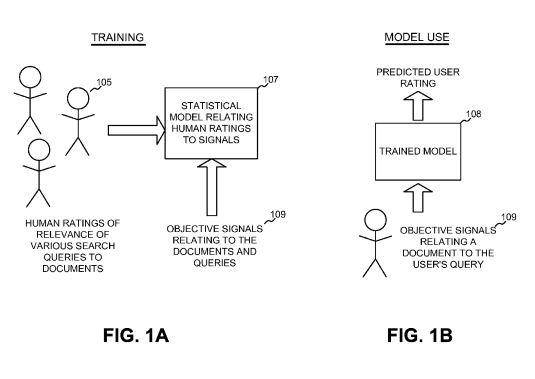
Source: www.seobythesea.com
Google uses search evaluators from different countries and with different languages. This means that Google is trying to understand content written in more languages.
Following this, we might think that the engine will be able to apply penalties to content coming in not so common languages as well. For the moment, by Google’s estimates, the Penguin algorithm affects approximately 3.1% of search queries in English, about 3% of queries in languages like German, Chinese, and Arabic. These trained experts might be able to catch spam in more languages and therefore affect the overall ranks.
9. A Video on Your Homepage Will Double the Chances to Show up on Page 1 of Google
All that YouTube has achieved in the last years made it the world’s second largest search engine and also the go-to choice for online video marketing and advertising. Let’s think of it for a moment. Everybody likes videos, right? They are instantly more attractive than text for lots of people and it seems that the big G holds a special place for Youtube in its heart. We should also take into account that, after all, it is owned by Google.
According to a study conducted by Tubular Insights, videos have a 41% higher CTR than text.
According to a study made by Aimclear, it seems that the platform we choose to upload our videos impacts the ability to rank. What platform is preferred? You guessed. YouTube dominates Google’s SERP, but there are other platforms that have some influence as well, as you can see in the image bellow:
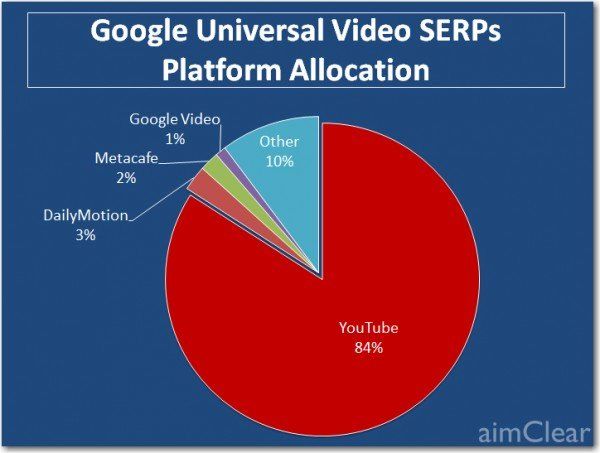
Source: www.aimclearblog.com
But what about having videos on homepages? Will they help us rank better in the organic search results? The same study from Aimclear mentioned above says that nearly 100% of the videos returned in universal SERPs also ranked on the first page on their native platform. It’s true that a high ranking on YouTube results doesn’t guarantees a universal search placement; yet it seems to be a prerequisite. Also, direct or indirect, videos are an effective SEO tactic and digital strategy that will boost your rankings. Aside from keeping your visitors engaged, it will give them something they can easily share.
A video can help by keeping your visitors more on your website and this will be seen as a ranking factor by the search engines. We should also consider the possibility of visitors sharing the page containing the video on social media and this will increase the possibility of receiving inbound links from users that notice it. This will certainly add value to your SEO.
10. Travel Time Is a Metric for Google’s Ranking
No, we are not talking about time traveling and time machines, but about the physical time it takes for someone to get from a location to an event/place/business he/she is interested in, and as a consequence, about local search and local optimization.
The amount of travel time someone goes through in order to reach a place is a ranking factor.
Travel time is a recently granted patent from Google that seems to be connected with the local SEO and is defined as the “time investment a person may be willing to make to visit a specific location.” Therefore, proximity comes first not just in our day to day lives but in SERPs as well. Sites that are not as optimized as yours will rank ahead of you if they are closer to the user. Therefore, if you have a local business you should be highly interested of this search market feature if you are interested in a high close rate as well.
Just look at the image below. The “plumbers” search listed a few businesses relevant for this search. Yet, why are these websites listed first?
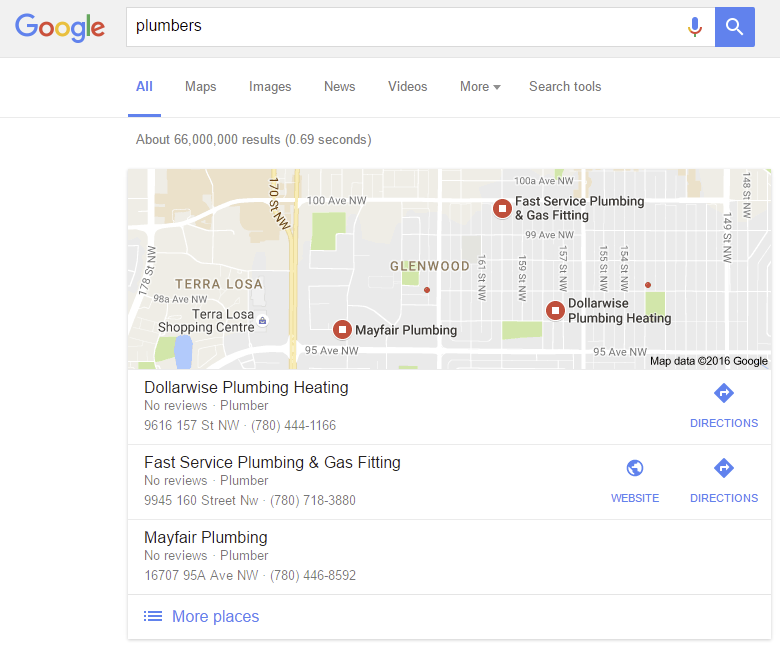
Source: moz.com
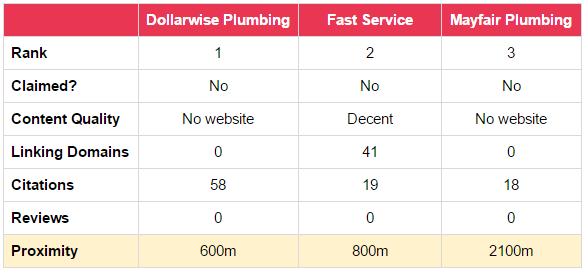
Do they have quality content? Well, some of them don’t even have a website, as we found out from a research conducted by Darren Shaw. Not to mention that some of them have 0 links and 0 reviews. Therefore, why are they ranking in top 3? You’ve guessed it: proximity. They are in top Google searches results because they offer local information, meaning relevant content to potential customers.
It seems like Google also wants to know if a person visits a place after seeing it in Google Maps, either by following a recommendation or after seeing it in the search results. As Bill Slawski mentioned, the term ”time investment” used in this Google patent refers to the actual time that it takes to visit a place that was seen in the search results.
11. Google Ranks Events Based upon Popularity
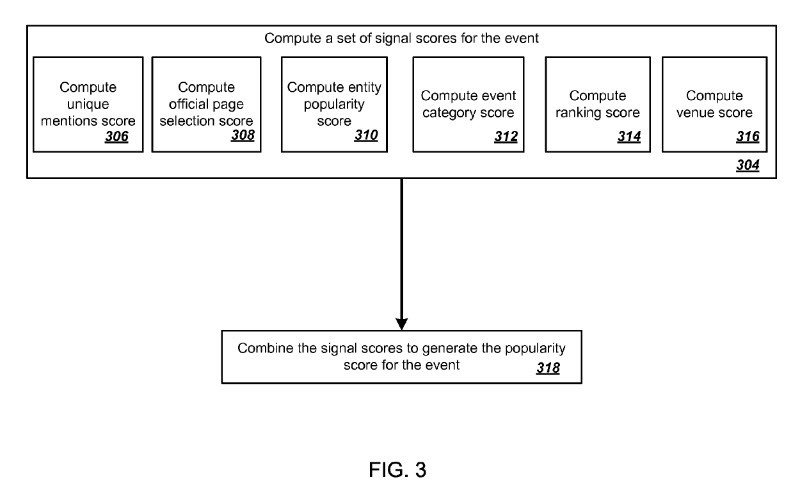
According to another patent granted for Google, it seems that the search engine will soon rank events depending on popularity instead of considering the number of inbound links pointed at the event’s pages. The idea behind this patent is that because many events can happen in the same region or around the same time, people that are interested in them might consider it difficult to choose the event to attend.
This will help users choose the most interesting event when multiple events take place at the same time.
The big G will be receiving data about the events that take place during a certain time period along with the computing signal scores for those events.
Other signals for ranking events according to the patent might be:
- generating an initial ranking of events based on the popularity scores;
- computing a modified popularity score for each of the events based on the initial ranking;
- generating the ranking of events occurring in the physical location by ranking the events according to the modified popularity scores.
Source: www.seobythesea.com
Conclusion
We’ve covered some of the SEO facts that we believe can make a real difference in how you approach organic search and digital marketing. Search is constantly evolving, with AI-powered experiences, changing user behavior, and new ranking systems reshaping how people discover information. Even so, the fundamentals remain the same: creating valuable content and making it easy for people to find continues to pay off.
Whether you’re investing in paid campaigns, link building, or content marketing, the long-term goal is still to earn sustainable organic visibility and attract the right audience. After all, a significant share of online journeys still begins with a search engine or an AI-powered search experience. That’s why staying informed about SEO trends and understanding the factors that influence your site’s performance is more important than ever.
There is no single SEO fact, statistic, or growth hack that guarantees success. The best results come from consistently applying proven strategies, adapting to change, and focusing on what provides value to users. The insights we’ve explored throughout this article can help strengthen your SEO, content, and broader marketing efforts, but they’re only part of the equation.
Keep learning, monitor how your audience searches and interacts with your content, invest in creating genuinely useful resources, and be willing to evolve as search evolves. The algorithms will continue to change, but websites that prioritize quality, trust, and user experience will always be in the strongest position.
We look forward to seeing how Google’s search engine will evolve with all the new technology and we also look forward to hearing from you.
Article reviewed by Catalin Dracsineanu






Yes these all are Shocking SEO Facts but I didn’t understand 9th one ” Travel Time Is a Metric for Google’s Ranking ” ?
Mahesh, it refers to the amount of time someone goes through in order to reach a place. For instance, if you are interested in restaurants and you google some places to eat, the first results you will be getting are probably with the restaurants are the closest to your location. Hope it’s all clear now 🙂
Huh, te first one is quite a surprise for me. I mean, it was among the msot important SEO rules not to duplicate content and now it is not a problem anymore. Of course it doesn’t mean we should now just do reposts but still it will be much easier to create content 🙂
Google has a different treatment for copied content than for duplicate content. Duplicate content won’t get you penalized, while copied content will. Or at least this is what Google said 😉
Thank you. Informative article, enlightened me on several key factors I should work on
I agree with all the points mentioned here but not agree with 1st point as I have been penalized for duplicate content a lots of time.
Thanks for your message, Katy! Google says that there is no such thing as “duplicate content penalty”. Yet, copied content will get you into troubles.
This is exactly What I said.
Still, we get trouble due to content duplication
This article is one of the best I’ve read in a very long time. I learn a great deal from Cog. SEO. Thank you!
Glad to hear that, Alton!
Hi! Cornelia, thanks for your beautiful post.
What do you think about Subtitles on YouTube?
They can help search engine, or not?
Best regards
Fulvio
Great question, Fluvio. We don’t know for sure if there is a direct correlation between subtitles and rankings. Yet, it seems like a great future research subject 😉
Interesting facts. So if someone looking for phrase – “florist Sydney” (on the computer), then theoretically he will see florists closest downtown Sydney?
Adam, yes, it seems that in some cases, Google is showing first the websites that are the closest to your location.
One of the most solid blog posts in the SEO space that I’ve seen a while! Great information all around! Stats regarding Google’s treatment of videos is also quite telling. Keep up the great work!
Glad you liked it, Doug 😉
Solid article. Google+ is deader than Elvis if you ask me. Backlinks still remain a strong factor of what ranks on Google.
Thanks, Luca! Google+ might not be the most vivid social network, yet, it seems to be a correlation between G+ signals and good ranks 😉
Wonderful and unique facts on SEO, Cornelia! The details I read when I went through the blog ‘Travel Time Is a Metric for Google’s Ranking’ amazed me the most.
Hey Cornelia Cozmiuc,
“Travel Time” as a ranking factor??? I never knew about this. This is something really interesting. Thanks for writing this article.I got something new to learn today.
Wow, love your article. Goggle seems to be placing more and more importance to location. Travel time will only become a bigger ranking factor as we go. Great info and spot on! Object detection really makes sense. I’ll add that to my list!
Glad to hear that, Thomas 🙂
Great post! I found it to be very informational and I’m definitely going to be uploading a YouTube video onto my home page now that I know it’s something Google is taking into consideration in regards to rankings. Thanks again and I’ll definitely be coming back for more!
Cornelia,
Well researched content. At least I have proof that for local SEO, duplicate content makes no difference in ranking.
All the points that you have mentioned are really shocking and I agree with these points. I believe that the video in the landing page has better chance to rank well.
Oh yeah.. my rank for one of articles jump higher right after I added a youtube video.
But don’t forget to add schema markup for the video, to help google that its very relevant to its article.
Hi.
I am a big fan of your blog. I had read many of your great articles and learn great techniques and methods to do proper research. This information again is very interesting and all case studies are very inspiring.
Travel metric happens only in cases when keyword is mentioned in detailed or low competition.
And competitive results appear in search engines on SEO & adwords only.
Hello Cornelia! SEO is really an interesting topic! So much to learn about it. I like how you actively respond to all the questions here in the comment section. Thank you for sharing all these information with us. Kudos to you!
Well researched information! These facts will surely help us improve our overall online marketing strategy. Thank you for sharing! Keep up the good work.
Great post Cornelia. I have noticed recently people doing some serious black hat stuff with social signals and it appears to be working very well for them!
Oh yeah.. my rank for one of articles jump higher right after I added a youtube video.
But don’t forget to add schema markup for the video, to help google that its very relevant to its article.
#1 is true even in 2020 and I don’t see this changing too much, especially if your niche has no been saturated by good competitors. And trust me, there are still way too many niches not even close to be saturated. SEO is still a gold digger tool.